Nesting Plan VII Formosan Wild Boar Public Art Installation by Into the Woods and Co. - Cheng Tsung Feng |
Home > Winners > #171887 |
 |
|
||||
| DESIGN DETAILS | |||||
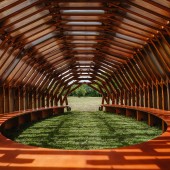
| DESIGN NAME: Nesting Plan VII Formosan Wild Boar PRIMARY FUNCTION: Public Art Installation INSPIRATION: The boar's instinctive behavior—its nesting actions, processes, materials, techniques, and functions—inspires the design. We utilized human construction materials and methods to reinterpret these elements, creating large, nest-like installation artworks that people can enter. Additionally, this work demonstrates the potential of using domestic materials and addressing the associated challenges, which Taiwanese artists and architects often overlook for aesthetic and practical reasons. UNIQUE PROPERTIES / PROJECT DESCRIPTION: Nesting Plan VII—Formosan Wild Boar is an artwork that reflects the unique ecological characteristics of Forest Park in Hualien. It honors the indigenous species of Formosan Wild Boar and explores its architectural abilities. The piece showcases boar's nesting instincts, such as using hay and branches to construct nests while keeping their snouts facing the entrance to remain alert. Additionally, the work integrates native wood and bamboo, harmonizing with the surrounding forest environment. OPERATION / FLOW / INTERACTION: This installation serves as both an artistic structure and a functional gathering space. It provides a semi-enclosed resting area where visitors can sit on the curved bench, naturally facing the entrance, just as the Formosa Wild Boar remains alert in its habitat. Moreover, using Taiwanese local materials ensures harmony with the forest, while the design fosters interaction, inviting people to experience nature through sight, touch, and presence. PROJECT DURATION AND LOCATION: The project commenced in June 2024 and was completed in September 2024. The unveiling ceremony for the artwork was held in the same month at Danongdafu Forest Park in Hualien, Taiwan. FITS BEST INTO CATEGORY: Fine Arts and Art Installation Design |
PRODUCTION / REALIZATION TECHNOLOGY: This art installation utilizes digital computation and precise structural design to overcome the challenges associated with domestic bamboo and wood materials. The primary structure is built with Taiwan Cedar timber, complemented by Makino Bamboo, ensuring stability and aesthetic appeal through meticulous joinery techniques. Inspired by the nesting behavior of the Formosan Wild Boar, the installation features a C-shaped circular bench that naturally orients users toward the entrance, mirroring the animal’s instinctive alert posture. This design enhances the interaction between the environment and the artwork while promoting sustainable local materials. SPECIFICATIONS / TECHNICAL PROPERTIES: Width 7m x Depth 7m x Height 5m TAGS: Taiwan Cedar, Makino Bamboo, public art, multifunctional space, sustainable design, Indigenous culture, forest-inspired, biomimicry, outdoor installation, ecological architecture RESEARCH ABSTRACT: We focused on the nesting skills of Formosan Wild Boars and explored how to translate their behaviors into artwork using local materials. Research involved field observation and material study, with data collected through close observation and expert interviews. Insights highlighted the potential of Taiwan Cedar and Makino Bamboo in promoting sustainability while aligning with nature. This work raises environmental awareness and showcases the intersection of ecology, sustainability, and design. CHALLENGE: The challenge of this work was to overcome the traditional reluctance in Taiwan to use domestic materials like Taiwan Cedar and Makino Bamboo in art and architecture due to their perceived weaknesses—such as low yield, irregular knots, and inherent softness. Additionally, creating an art installation that mimics the nesting behavior of Formosan Wild Boars while ensuring structural safety and aesthetic appeal posed a significant challenge in balancing function, form, and sustainability. ADDED DATE: 2025-03-13 04:16:54 TEAM MEMBERS (3) : Producer: Hualien Branch, Forestry and Nature Conservation Agency, Project Director: Into the Woods & Co. and Artist: Cheng Tsung FENG IMAGE CREDITS: Image #1-#5: FIXER Photographic Studio, Taiwan. |
||||
| Visit the following page to learn more: https://reurl.cc/OY1jzr | |||||



| CLIENT/STUDIO/BRAND DETAILS | |
 |
NAME: Hualien Branch, Forestry and Nature Conservation Agency PROFILE: The Forestry and Nature Conservation Agency of Taiwan is a governmental organization dedicated to the sustainable management of forests and the conservation of natural ecosystems. Taiwan, with a forest coverage rate of 60.71%, considers forests a vital national resource. In line with global environmental protocols, the agency responds to challenges such as climate change, ecological imbalance, and biodiversity loss through forest-based strategies. Guided by principles of environmental protection, economic development, and social equity, the agency implements a range of initiatives, including cultivating healthy forests, establishing a forest value chain, preventing illegal logging, strengthening national forest governance, and managing nature reserves. It also promotes mountain-village ecological economies and supports community-based conservation. Moving forward, the agency focuses on prohibiting logging in natural forests, managing economic forests under international frameworks, and advancing the Satoyama Initiative to foster harmony between human communities and nature. |

| AWARD DETAILS | |
 |
Nesting Plan Vii Formosan Wild Boar Public Art Installation by Into The Woods and Co.-Cheng Tsung Feng is Winner in Fine Arts and Art Installation Design Category, 2024 - 2025.· Read the interview with designer Into the Woods and Co. - Cheng Tsung Feng for design Nesting Plan VII Formosan Wild Boar here.· Press Members: Login or Register to request an exclusive interview with Into the Woods and Co. - Cheng Tsung Feng. · Click here to register inorder to view the profile and other works by Into the Woods and Co. - Cheng Tsung Feng. |
| SOCIAL |
| + Add to Likes / Favorites | Send to My Email | Comment | Testimonials | View Press-Release | Press Kit |
Did you like Into The Woods and Co.-Cheng Tsung Feng's Fine Art Design?
You will most likely enjoy other award winning fine art design as well.
Click here to view more Award Winning Fine Art Design.
  |
 |