Cosmic Creek Commercial Architecture by Jing Xu and Gang Liu |
Home > Winners > #166726 |
 |
|
||||
| DESIGN DETAILS | |||||
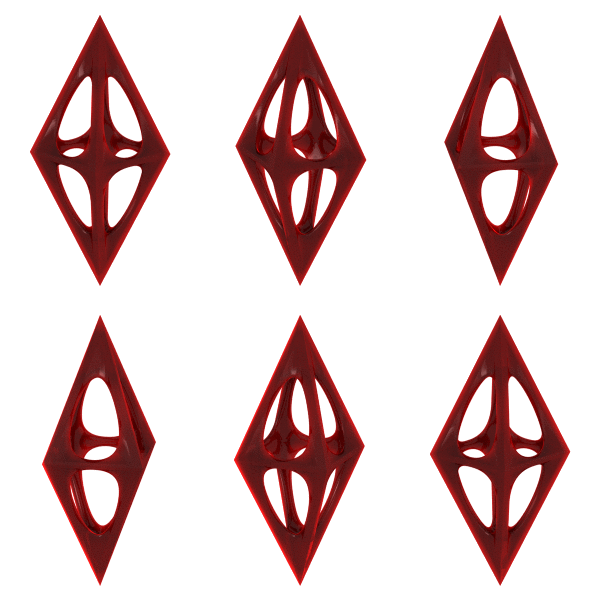
| DESIGN NAME: Cosmic Creek PRIMARY FUNCTION: Commercial Architecture INSPIRATION: The Cosmic Creek was inspired by the concept of creating a seamless connection between nature and urban life, with a focus on interaction and community. Drawing from Chengdu's cultural ties to water, the design integrates research on topography and ecological systems to craft spaces that resonate with human behavior. The goal was to foster a sustainable environment where daily activities blend with natural elements, redefining how commercial spaces interact with their surroundings and users. UNIQUE PROPERTIES / PROJECT DESCRIPTION: The Cosmic Creek in Luxelakes Chengdu, spans 100,000 sqm, blending urban spaces with natural landscapes. Its "L-shaped" water system shapes terraced spaces for play and relaxation. A central square with cascading waterfalls and a geometric ring offers vibrant activity and city views. Featuring "Ginkgo Leaf Units" for shade, irrigation, and lighting, the project integrates modern design with oriental aesthetics, redefining urban space through sustainability and nature-commerce harmony. OPERATION / FLOW / INTERACTION: The Cosmic Creek operates as an interactive public space where water and architecture engage visitors. Water flows through the terraced site, encouraging exploration and interaction. The Leaf Units provide shade and lighting, while the central square and waterfalls act as focal points for gathering. The layout fosters smooth pedestrian movement, offering a continuous, engaging experience. By integrating nature and commerce, it enhances social interactions and sustainability, creating a more vibrant urban environment. PROJECT DURATION AND LOCATION: The project began in May 2021 in Chengdu, China, within the Luxelakes Eco City in the Tianfu New District. It is currently under construction and is expected to be completed in 2026/2027. The design has been continuously refined to ensure the project meets its ecological, commercial, and community goals, transforming urban space with a harmonious integration of nature. FITS BEST INTO CATEGORY: Architecture, Building and Structure Design |
PRODUCTION / REALIZATION TECHNOLOGY: The project employs full-digital construction techniques to address varied elevation changes and ensure precision. Prefabrication and customization were key, particularly for unique structures like the Ginkgo Leaf Units, crafted with steel and executed through digitally controlled construction methods. Close collaboration with landscape design integrated thematic elements, such as tree planters and waterfalls, directly tied to façade geometry, creating seamless green and experiential spaces. SPECIFICATIONS / TECHNICAL PROPERTIES: The Cosmic Creek covers a total site area of 100,000 square meters. The project's central feature, a geometric ring-shaped structure (UFO), has a diameter of 106 meters and is elevated approximately 17 meters above the ground, offering 360-degree city views. The "L-shaped" water system features terraced elevations ranging from 1 to 6 meters, with the entire site interconnected by gentle slopes for an engaging pedestrian experience. The Ginkgo Leaf Units range in height from 15 meters to 11 meters, integrating independent irrigation, planting, and lighting systems. TAGS: Urban design, sustainable architecture, water system, public space, commercial street, ecological integration, Chengdu, terraced landscape, Leaf Units, nature-inspired design RESEARCH ABSTRACT: The Cosmic Creek research explored how water, nature, and architecture can blend to enhance social interactions and sustainability in urban spaces. Using site analysis, topographic surveys, climate studies, and behavioral observations, the design integrates water systems with human interaction. The result is a dynamic, water-centric urban space fostering community engagement. This approach redefines public spaces, demonstrating how sustainability and commerce can coexist in urban planning. CHALLENGE: One of the main challenges of The Cosmic Creek was the varying site elevations. With natural topographical differences, it was crucial to precisely manage the transitions between different levels while ensuring smooth circulation and functionality. To address this, the team developed a new system using gradient ramps and multi-level pathways to connect different areas, avoiding the constraints of traditional floor layouts. Additionally, the design process emphasized close collaboration between architecture, landscape, and structural teams to ensure coordination and feasibility. ADDED DATE: 2024-12-30 06:00:08 TEAM MEMBERS (2) : 00Group and Wide Horizon Investment Group IMAGE CREDITS: Image credits: #NO1 00Group+Iruler #NO2 Wide Horizon #NO3 Wide Horizon #NO4 Wide Horizon #NO5 00Group+Iruler Video Credits: 00Group+Iruler Construction Photo Credits: 00Group+Wide Horizon PATENTS/COPYRIGHTS: The design is protected under copyright by 00GROUP. Copyrights belong to Jing Xu and Gang Liu, 2024. |
||||
| Visit the following page to learn more: https://www.00-group.cn/W2 | |||||


| CLIENT/STUDIO/BRAND DETAILS | |
 |
NAME: 00Group PROFILE: 00Group is a Shanghai-based architectural design firm founded by Jing Xu and Gang Liu. With a foundation rooted in oriental aesthetics, the firm strives to explore contemporary design through a diverse range of projects. 00Group aims to create architecture that fosters a seamless integration between built environments and the natural world, emphasizing spatial forms and thoughtful responses to context. They approach each project with curiosity and a passion for innovative problem-solving, embracing cutting-edge technologies to deliver impactful, sustainable, and human-centered designs. |

| AWARD DETAILS | |
 |
Cosmic Creek Commercial Architecture by Jing Xu and Gang Liu is Winner in Architecture, Building and Structure Design Category, 2024 - 2025.· Read the interview with designer Jing Xu and Gang Liu for design Cosmic Creek here.· Press Members: Login or Register to request an exclusive interview with Jing Xu and Gang Liu. · Click here to register inorder to view the profile and other works by Jing Xu and Gang Liu. |
| SOCIAL |
| + Add to Likes / Favorites | Send to My Email | Comment | Testimonials | View Press-Release | Press Kit |
Did you like Jing Xu and Gang Liu's Architecture Design?
You will most likely enjoy other award winning architecture design as well.
Click here to view more Award Winning Architecture Design.
  |
 |