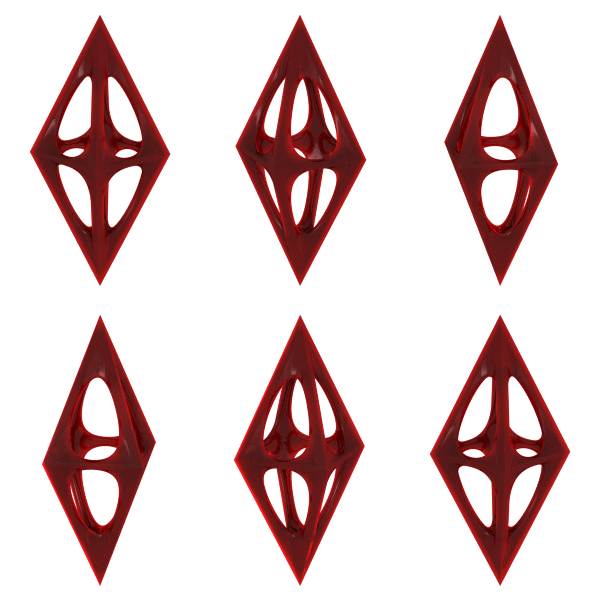
Green Island Urban Power Substation by Xudong Zhu |
Home > Winners > #166588 |
 |
|
||||
| DESIGN DETAILS | |||||
| DESIGN NAME: Green Island PRIMARY FUNCTION: Urban Power Substation INSPIRATION: This project was inspired by a desire to blend essential infrastructure with urban vitality. Motivated by the potential to turn functional structures into assets for the city, I aimed to create a sustainable design that balances energy efficiency with ecological and social benefits. Drawing from research in green architecture, the project transforms a passive boundary into an active public space that fosters harmony between nature and the urban environment. UNIQUE PROPERTIES / PROJECT DESCRIPTION: The power substation uses a double-skin facade to create a “breathing, growing, and energy-storing” Green Island, blending infrastructure with vibrant public space. Solar panels on the south and east maximize energy efficiency, while the north and west feature green walls with planting troughs. The southern facade shields traffic noise and transforms the edge into a lively linear park, connecting neighborhoods and fostering community engagement. OPERATION / FLOW / INTERACTION: This project combines energy efficiency and urban vitality by using solar panels on sunlit sides to generate power and adjustable panels that provide shade and shelter for pedestrians. The green walls grow with the seasons, creating a dynamic and eco-friendly facade. The design transforms the space into a welcoming park, reducing noise, improving air quality, and connecting neighborhoods, making it both functional and inviting for the community. PROJECT DURATION AND LOCATION: The project designed in September 2024 in Shanghai, China. FITS BEST INTO CATEGORY: Architecture, Building and Structure Design |
PRODUCTION / REALIZATION TECHNOLOGY: The design was developed using a research-driven approach, integrating sustainable strategies and advanced modeling techniques. A double-skin facade system was employed, combining solar photovoltaic panels on sun-facing sides for energy efficiency and perforated aluminum panels with planting troughs on shaded facades to foster biodiversity. Parametric design tools optimized the facade's performance, ensuring a balance between functionality, aesthetics, and ecological benefits. SPECIFICATIONS / TECHNICAL PROPERTIES: The project is located on a 50,000 mm x 70,000 mm site, with a total building height of 12,000 mm. TAGS: Green Island, Public Space, Urban Infrastructure, Ecological Design, Sustainability, Power Substation, Double-skin Facade RESEARCH ABSTRACT: This applied research aimed to transform infrastructure into vibrant public spaces, focusing on sustainability and urban connectivity. Using sunlight analysis, energy modeling, and environmental simulations, we gathered data with parametric tools. Community feedback and expert insights informed the design. Results showed solar panels enhance energy efficiency, while green walls improve air quality and biodiversity. The project highlights how infrastructure can unite ecological, social, and functional goals. CHALLENGE: The hardest part was balancing strict regulations with innovative design. Local laws restricted changes to building footprints, limiting structural flexibility. Socially, the challenge was transforming a utilitarian substation into a community asset. Technologically, optimizing the double-skin facade for energy efficiency while supporting dynamic green walls required advanced simulations. Overcoming these obstacles involved integrating research, creativity, and stakeholder collaboration. ADDED DATE: 2024-12-27 16:10:48 TEAM MEMBERS (1) : IMAGE CREDITS: All credit to Xudong Zhu |
||||


| CLIENT/STUDIO/BRAND DETAILS | |
 |
NAME: T.E.N PROFILE: Founded in 2019 in Shanghai, China, T.E.N is a multidisciplinary design and research studio specializing in architecture, urban planning, and landscape design. The studio has received recognition through awards such as the BLT Global Emerging Architect of the Year 2022, inclusion in the China New Architects' Ranking in 2022 and 2023, and the 2024 LOOP Design Awards Best Young & Concept Arch Firm. T.E.N's core team includes professionals with academic backgrounds from institutions such as Harvard University, the University of Cambridge, ETH Zurich, and Tongji University, alongside experience at leading firms like UNStudio, KPF, NBBJ, and SASAKI. Their expertise spans various project scales and functions, complemented by roles in project development at organizations such as JLL and the University of Cambridge Real Estate Machine Learning Laboratory. The studio focuses on innovative spatial typologies, particularly in rural revitalization, urban renewal, and public spaces. By integrating advanced technologies such as parametric design, virtual reality, and AI with sustainable practices, T.E.N addresses contemporary challenges. Guided by the principles of Technology, Economy, and Nature, the studio strives to create designs that harmonize functionality, community, and environmental stewardship. |

| AWARD DETAILS | |
 |
Green Island Urban Power Substation by Xudong Zhu is Winner in Architecture, Building and Structure Design Category, 2024 - 2025.· Read the interview with designer Xudong Zhu for design Green Island here.· Press Members: Login or Register to request an exclusive interview with Xudong Zhu. · Click here to register inorder to view the profile and other works by Xudong Zhu. |
| SOCIAL |
| + Add to Likes / Favorites | Send to My Email | Comment | Testimonials | View Press-Release | Press Kit |
Did you like Xudong Zhu's Architecture Design?
You will most likely enjoy other award winning architecture design as well.
Click here to view more Award Winning Architecture Design.
  |
 |