Sreed Ebisu T Office Building by Salhaus |
Home > Winners > #163949 |
 |
|
||||
| DESIGN DETAILS | |||||
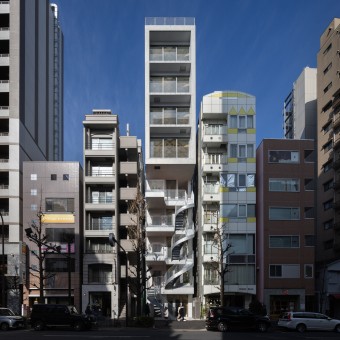
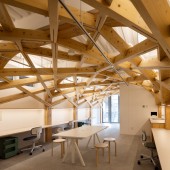
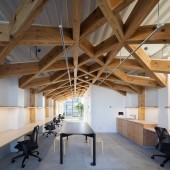
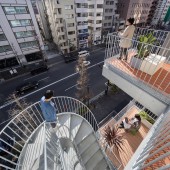
| DESIGN NAME: Sreed Ebisu T PRIMARY FUNCTION: Office Building INSPIRATION: The design of this building was carried out during the COVID-19 pandemic. People stayed home; some even said office buildings were no longer necessary. In this project, we considered what kind of workspace would be worth visiting and working in even after online working technology was established. Our answer was architecture, which provides the comfort of a home and maximizes the value of working together. UNIQUE PROPERTIES / PROJECT DESCRIPTION: This project is a nine-story office building in Tokyo. We tried to create a new prototype for urban timber architecture in this project. Our proposal was a hybrid structure of a steel post-and-beam frame and timber seismic frames inserted into it. This timber frame, which we call a "seismic timber lattice shell," is not only a structural but also an interior element to realize new workspaces where people can work in a more relaxed mode, enjoying the spatial value of the timber construction. OPERATION / FLOW / INTERACTION: In addition to creating an intimate workspace wrapped in timber on each floor, we created rich common spaces to facilitate workers' interaction. We designed a staircase not only as a simple evacuation route but also as a daily traffic route and arranged many common terraces along it. Taking a break outdoors or communicating with people from other companies will activate collaboration and creativity among workers. PROJECT DURATION AND LOCATION: This building's site is located in Ebisu, Shibuya-ward, Tokyo. We designed the building from June 2020 to June 2021, and construction work was carried out from June 2021 to January 2023. The building was put into use immediately after that, and all floors are currently rented out to tenants. FITS BEST INTO CATEGORY: Architecture, Building and Structure Design |
PRODUCTION / REALIZATION TECHNOLOGY: Urban timber architectures, which have recently been booming in Japan, are dominated by multi-story buildings with post-and-beam frames that have acquired special fire-resistance certification. However, these buildings simply replace RC or steel-frame construction with timber and do not possess the spatiality unique to timber construction. Our goal was to create a new typology of urban timber architectures that maximizes the spatial value of timber construction and allows end users to enjoy the value. SPECIFICATIONS / TECHNICAL PROPERTIES: This project is a 9-story, 34.3m-high rental building with a total floor area of 564.7m2 and a footprint of 80.0m2. The ground and first floors are for restaurants or retail stores, and the third to ninth floors are for offices. It has an evacuation staircase and an evacuation balcony on each floor required by law, and an elevator. In addition, it is a fireproof building under the Building Standards Act. TAGS: Architecture, Timber, urban, Office, workspace RESEARCH ABSTRACT: Two primary motivations for promoting the construction of timber buildings in Japan today are, reducing CO2 emissions during construction and making use of the vast forest stock. Structural strength and fire resistance are the main issues when employing timber for urban buildings. We developed a method of using timber as a seismic element to brace steel frames, which can also work as an exposed interior element; structural members that only act against seismic force do not require fireproofing. CHALLENGE: As this was an unprecedented construction method, we put great effort into the detailed design of the steel and timber joints. During the construction phase, we formed a team with a contractor, a steel fabricator, and a timber fabricator, both with high technical capabilities, and worked out the details of the joints while sharing 3D data. In addition, there were differences in the production accuracy between the two fabricators, so we paid close attention to the accuracy management on site. ADDED DATE: 2024-09-10 07:36:02 TEAM MEMBERS (4) : Architect: Motoki Yasuhara , Architect: Masashi Hino, Architect: Mari Tochizawa and Structural Engeneer: Jun Sato IMAGE CREDITS: Image #1:Photographer Makoto Yoshida, 2023 Image #2:Photographer Makoto Yoshida, 2023 Image #3:Photographer Makoto Yoshida, 2023 Image #3:Photographer Makoto Yoshida, 2023 Image #4:Photographer Makoto Yoshida, 2023 |
||||
| Visit the following page to learn more: https://salhaus.com/ | |||||

| CLIENT/STUDIO/BRAND DETAILS | |
 |
NAME: SAPPORO REAL ESTATE CO., LTD PROFILE: - |

| AWARD DETAILS | |
 |
Sreed Ebisu T Office Building by Salhaus is Winner in Architecture, Building and Structure Design Category, 2024 - 2025.· Read the interview with designer Salhaus for design Sreed Ebisu T here.· Press Members: Login or Register to request an exclusive interview with Salhaus. · Click here to register inorder to view the profile and other works by Salhaus. |
| SOCIAL |
| + Add to Likes / Favorites | Send to My Email | Comment | Testimonials | View Press-Release | Press Kit |
Did you like Salhaus' Architecture Design?
You will most likely enjoy other award winning architecture design as well.
Click here to view more Award Winning Architecture Design.
  |
 |