Weaving Wood Cabinet by ZKW Studio |
Home > Winners > #172721 |
 |
|
||||
| DESIGN DETAILS | |||||
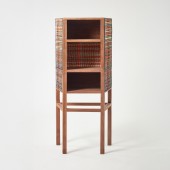
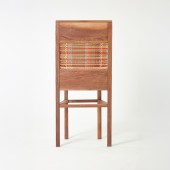
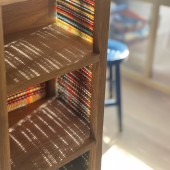
| DESIGN NAME: Weaving Wood PRIMARY FUNCTION: Cabinet INSPIRATION: Inspired by the balanced spirit of nature, this cabinet reinterprets a classic trapezoidal form with three side panels composed of walnut veneer textile. The veneer is woven more densely near the frame, creating a visual and tactile gradient , not only in the viewing but also in the tactile experience. By blending rigid walnut with flexible textile, the piece explores harmony through material, offering a unique sensory experience that invites closer interaction and touch. UNIQUE PROPERTIES / PROJECT DESCRIPTION: This piece of furniture employs a unique weaving technique that integrates walnut veneer into textile, transforming the originally fabric into a unique screen. When exposed to sunlight, the woven surface casts delicate and beautiful shadows. Weaving veneer into textile is a unique technique that machines are not capable of doing. Each wooden board undergoes a meticulous selection based on its grain and color, building a consistent sense of nature beauty. OPERATION / FLOW / INTERACTION: The cabinet features a slender profile suited for storing small objects, making it well-suited to living spaces and compact interiors. Its low height allows it to sit neatly beside a television, serving as a functional storage piece. Designed to be freestanding, the cabinet reveals its tactile quality when illuminated. Sunlight filtering through the woven textile creates a soft interplay of light and shadow. The pale-toned fabric responds gently to natural light, introducing a sense of airy and a renewed lightness to the surrounding space. PROJECT DURATION AND LOCATION: The project started in October 2023 and finished in March 2024 in United States, and was exhibited in ICFF WANTED in May 2024. FITS BEST INTO CATEGORY: Furniture Design |
PRODUCTION / REALIZATION TECHNOLOGY: This cabinet is entirely handcrafted from walnut, including the textile panels on both sides, which are woven from a combination of cotton thread and walnut veneer. The technique of integrating wood veneer into textile weaving is a process that cannot be replicated by machines. Due to the hardness and thickness of the walnut veneer, the tension of the weave must be carefully and continuously adjusted—tight enough to securely hold the veneer strips in place, yet flexible enough to maintain structural integrity without causing displacement. SPECIFICATIONS / TECHNICAL PROPERTIES: W * D * H : 508 * 304 * 1118 mm TAGS: Cabinet, Veneer Textile, Furniture, Material Innovation, Indoor Furniture RESEARCH ABSTRACT: The project is rooted in a deep investigation of materials and making techniques, centering on a textile innovation that integrates thin walnut veneer into a woven structure using a loom. The process involved extensive experimentation, beginning with a series of prototypes that tested veneer thicknesses, thread weights, and weaving patterns. A key challenge was preserving the tension necessary for weaving while accommodating the rigidity of wood—an issue resolved through careful calibration of spacing, tension, and structural support. Traditional weaving tools were adapted for this process, with each strip of veneer hand-cut and softened for flexibility before being woven alongside cotton thread. Machines proved incompatible with the delicacy and precision required, making the technique entirely dependent on manual craftsmanship. The final textile achieves both strength and fluidity, allowing the wood grain to appear continuous across a pliable surface. In parallel with material research, the project draws on classical furniture forms—particularly the trapezoidal cabinet, a shape now rare in contemporary contexts. Reinterpreted through this new textile language, the form is both familiar and reimagined, merging historic references with a distinctly modern sensibility. CHALLENGE: The project posed creative and technical challenges, particularly in adapting thick wood veneer for weaving. Wood veneer lacks the tension typically required by a loom and thread fabric, making it necessary to carefully calculate the spacing between each column to maintain a good structure. Beyond the textile, the frame designed to hold the textile became another big technical challenge. Though the grooves are invisible from the outside, there are 28 hidden channels that secure the woven surface in place. Due to their seamless requirement and the thinness of each wooden board, cutting precise grooves along narrow edges proved fine-tuned craftsmanship, merging material research with construction precision. ADDED DATE: 2025-04-02 18:46:10 TEAM MEMBERS (1) : Textile Partner: Huining Liu IMAGE CREDITS: ZKW Studio, 2024. |
||||
| Visit the following page to learn more: https://www.keweizhao.com/case/weavingve |
|||||

| CLIENT/STUDIO/BRAND DETAILS | |
 |
NAME: ZKW Studio PROFILE: ZKW Studio is dedicated to cultivating natural tranquility within living spaces. By integrating abstract natural elements with self-developed materials, the studio embarks on a journey into the wild, bringing back new inspirations transformed into furniture design. With a poetic design language and a distinctive artistic perspective, ZKW Studio explores new possibilities for the home and modern living. |

| AWARD DETAILS | |
 |
Weaving Wood Cabinet by Zkw Studio is Winner in Furniture Design Category, 2024 - 2025.· Read the interview with designer ZKW Studio for design Weaving Wood here.· Press Members: Login or Register to request an exclusive interview with ZKW Studio. · Click here to register inorder to view the profile and other works by ZKW Studio. |
| SOCIAL |
| + Add to Likes / Favorites | Send to My Email | Comment | Testimonials | View Press-Release | Press Kit |
Did you like Zkw Studio's Furniture Design?
You will most likely enjoy other award winning furniture design as well.
Click here to view more Award Winning Furniture Design.
  |
 |