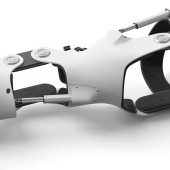
Repawse Pet Power Assistive Exoskeleton by Leijing Zhou |
Home > Winners > #172611 |
 |
|
||||
| DESIGN DETAILS | |||||
| DESIGN NAME: Repawse PRIMARY FUNCTION: Pet Power Assistive Exoskeleton INSPIRATION: The inspiration for this project originated from a news report highlighting customized prosthetics for disabled pets, exposing significant limitations in current solutions. Coupled with my personal experience of caring for my own dog after its hindlimb injury, I recognized the broader societal need to extend humane, intelligent rehabilitation technology from human healthcare into pet care, ultimately enhancing animal welfare. UNIQUE PROPERTIES / PROJECT DESCRIPTION: In response to the rehabilitation needs of disabled pets, we have developed a canine rehabilitation exoskeleton based on surface electromyographic (sEMG) control. By collecting sEMG signals from the healthy forelimb, the system drives the hindlimb actuators in real time to synchronise gait. Combined with 3D printing for custom design, it provides precise movement assistance for disabled dogs, embodying the technological protection of animal life dignity. OPERATION / FLOW / INTERACTION: When the dog walks, sensors detect muscle signals (sEMG) from the healthy forelimb. These signals are processed to predict the movement intention of the impaired hindlimb, triggering linear actuators in real time. This active, intuitive assistance ensures natural movement, aiding rehabilitation efficiently. PROJECT DURATION AND LOCATION: The project started in 2023 in Hangzhou and finished in March 2025 in Hangzhou. |
PRODUCTION / REALIZATION TECHNOLOGY: The exoskeleton is produced through advanced 3D printing technology allowing individual customization based on precise body scans. Lightweight, durable materials, including soft memory foam lining, aluminum alloy for structural parts, and anti-slip rubber soles, ensure strength, comfort, and safety in daily use. SPECIFICATIONS / TECHNICAL PROPERTIES: Dimensions: 220mm × 200mm × 540mm Materials: Aluminum alloy frame, soft memory foam lining, rubber soles Technology: Surface EMG sensors, linear actuators, microcontroller-base TAGS: Pet Rehabilitation, Animal Welfare, Exoskeleton, sEMG Signal, Active Control, 3D-Printing, Customized Design, Assistive Mobility RESEARCH ABSTRACT: This project originated from a news report on prosthetic limbs for disabled pets, highlighting the pros and cons of current solutions. Inspired, we explored transferring active-control exoskeleton technology—origina CHALLENGE: The primary challenge was accurately interpreting animal intention through muscle signals, with few existing precedents or standards. Historically, disabled pets faced limited and uncomfortable assistive solutions. Technologically, creating lightweight yet robust actuators and ensuring comfort required extensive material research, innovative mechanical design, and iterative prototyping with real pets. ADDED DATE: 2025-03-31 09:32:44 TEAM MEMBERS (11) : Menghan Li, Leijing Zhou, Xinmiao Shen, Xiaofei Gong, Xiaotong Guan, Ding Ding, Jinjie Li, Qianyi Wang, Keyin Chen, Zixiang Wang and Zihan Zhang IMAGE CREDITS: Leijing Zhou, 2024. |
||||



| CLIENT/STUDIO/BRAND DETAILS | |
 |
NAME: Zhejiang University PROFILE: Zhejiang University is a public university in Hangzhou, Zhejiang, China. It is affiliated with the Ministry of Education. The university is part of Project 211, Project 985, and the Double First-Class Construction. The university holds 7 faculties, 37 colleges, schools, and departments, offering 140 undergraduate and 300 graduate programs. The university also has seven affiliated hospitals, 1 museum, and 2 international joint institutes. The university is a member of the C9 League. |

| AWARD DETAILS | |
 |
Repawse Pet Power Assistive Exoskeleton by Leijing Zhou is Winner in Pet Care, Toys, Supplies and Products for Animals Design Category, 2024 - 2025.· Read the interview with designer Leijing Zhou for design Repawse here.· Press Members: Login or Register to request an exclusive interview with Leijing Zhou. · Click here to register inorder to view the profile and other works by Leijing Zhou. |
| SOCIAL |
| + Add to Likes / Favorites | Send to My Email | Comment | Testimonials | View Press-Release | Press Kit |
Did you like Leijing Zhou's Pet Care Design?
You will most likely enjoy other award winning pet care design as well.
Click here to view more Award Winning Pet Care Design.
  |
 |