Guardian Deaf-mute Helmet by Leijing Zhou |
Home > Winners > #172601 |
 |
|
||||
| DESIGN DETAILS | |||||
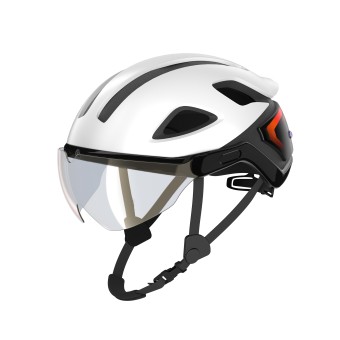
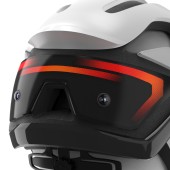
| DESIGN NAME: Guardian PRIMARY FUNCTION: Deaf-mute Helmet INSPIRATION: This project was inspired by the overlooked risks faced by deaf-mute cyclists in sound-dominated traffic environments. Motivated by a desire to create inclusive safety solutions, I explored how smart technology could bridge the sensory gap. Grounded in user-centered research and assistive tech studies, the design aims to challenge auditory bias in urban mobility and offer a more equitable, responsive riding experience for all. UNIQUE PROPERTIES / PROJECT DESCRIPTION: Due to their inability to communicate effectively through speech and sound, deaf-mute individuals may face significant dangers when traveling, lacking essential information about road conditions. The deaf-mute safety helmet robustly protects cyclists with smart technology, sensors, and an advanced HUD system. It alerts them to traffic conditions through precise vibrations, sustaining alertness. The helmet significantly bolsters safety while cycling, lowering accident risks. OPERATION / FLOW / INTERACTION: The helmet is easy to use—just wear it and ride as usual. It gently vibrates to warn you if something gets too close from behind, and flashes lights to keep you alert. When it's time to turn, it shows directions and flashes the right signal. If an accident happens, it automatically calls for help. With just a light tap, you can also send a preset message. It fits snugly with a twist of the knob, making cycling safer and more reassuring. PROJECT DURATION AND LOCATION: The project started in June 2023 in China and finished in October 2024 in China. |
PRODUCTION / REALIZATION TECHNOLOGY: The design was developed through user-centered research, focusing on the travel challenges faced by deaf-mute individuals. Prototyping involved computer-aided design modeling and iterative testing with simulated vibration and head-up display feedback. The helmet is envisioned using lightweight acrylonitrile butadiene styrene for the shell, memory foam for comfort, and integrates sensors, cameras, and light-emitting diode modules to ensure safety and usability. SPECIFICATIONS / TECHNICAL PROPERTIES: 250 (mm) x 200 (mm) x 200 (mm) TAGS: Inclusive Design, Deaf-Mute Safety, Smart Helmet, Assistive Technology, Urban Mobility, Vibration Feedback, Road Safety RESEARCH ABSTRACT: Amid honks and sirens, sound protects most but leaves deaf-mute cyclists exposed. We conducted user-centered design research aiming to improve their travel safety. Through interviews, observations, and journey mapping, we gathered insights from deaf-mute individuals and cyclists. Results revealed key dangers like missed warnings and lack of emergency help. This led to features like vibration alerts and auto-alarm, promoting inclusive design and raising awareness in both society and mobility products. CHALLENGE: The hardest part was designing a system that replaces sound-based warnings with intuitive, non-auditory feedback. Socially, deaf-mute cyclists are often overlooked, with few products considering their needs. Technologically, integrating sensors, HUD, and vibration modules into a compact, wearable form was complex. Limited reference cases and data made user research crucial. Overcoming these challenges required empathy, iteration, and creative use of existing tech in new ways. ADDED DATE: 2025-03-31 06:49:41 TEAM MEMBERS (12) : Menghan Li, Leijing Zhou, Xiaofei Gong, Xiaotong Guan, Xinmiao Shen, Ding Ding, Kaiyue Cai, Jinjie Li, Qianyi Wang, Keyin Chen, Zixiang Wang and Zihan Zhang IMAGE CREDITS: Leijing Zhou, 2024. |
||||



| CLIENT/STUDIO/BRAND DETAILS | |
 |
NAME: Zhejiang University PROFILE: Zhejiang University is a public university in Hangzhou, Zhejiang, China. It is affiliated with the Ministry of Education. The university is part of Project 211, Project 985, and the Double First-Class Construction. The university holds 7 faculties, 37 colleges, schools, and departments, offering 140 undergraduate and 300 graduate programs. The university also has seven affiliated hospitals, 1 museum, and 2 international joint institutes. The university is a member of the C9 League. |

| AWARD DETAILS | |
 |
Guardian Deaf-Mute Helmet by Leijing Zhou is Winner in Safety Clothing and Personal Protective Equipment Design Category, 2024 - 2025.· Read the interview with designer Leijing Zhou for design Guardian here.· Press Members: Login or Register to request an exclusive interview with Leijing Zhou. · Click here to register inorder to view the profile and other works by Leijing Zhou. |
| SOCIAL |
| + Add to Likes / Favorites | Send to My Email | Comment | Testimonials | View Press-Release | Press Kit |
Did you like Leijing Zhou's Protective Equipment Design?
You will most likely enjoy other award winning protective equipment design as well.
Click here to view more Award Winning Protective Equipment Design.
  |
 |