Inair AR Spatial Computer by Inair Design Team |
Home > Winners > #171731 |
 |
|
||||
| DESIGN DETAILS | |||||
| DESIGN NAME: Inair PRIMARY FUNCTION: AR Spatial Computer INSPIRATION: As digitalization accelerates, traditional work remains limited by hardware, fragmented interactions, and inefficiency. Remote work is expanding, but its adoption varies. More than 50% of jobs in finance and IT can be done remotely, while roles that require collaboration or specialized tools face challenges. People seek freedom from spatial and device constraints, aiming for seamless productivity and a better work-life balance. UNIQUE PROPERTIES / PROJECT DESCRIPTION: Inair is an AR spatial computing device built for productivity, seamlessly blending a virtual workspace into a lightweight headset and main unit for an immersive, portable experience. With refined ergonomics and intuitive spatial interactions, Inair redefines UI constraints, enabling applications to be systematically arranged and dynamically managed. Its cutting-edge multimodal AI recognition powers proactive, intelligent interactions, delivering a groundbreaking integrated experience. OPERATION / FLOW / INTERACTION: Inair enables intuitive and efficient interaction through spatial raycasting, touch, motion sensing, and voice control. Users can navigate interfaces via gaze selection, gesture tapping, or touch sliding. Keyframes include interface activation, window switching, and interaction confirmation. A linear motor provides haptic feedback for enhanced precision. The AI assistant predicts user needs based on behavior, enabling seamless multitasking with minimal intervention, making interactions smarter and more efficient. PROJECT DURATION AND LOCATION: The project was launched in Beijing and Hong Kong in August 2024 and has received multiple prestigious awards, including 36Kr’s “Future Business King of the Year,” GeekPark’s “Favorite Product of the Year,” and the Golden Gyro Award for “Best Emerging VR/AR Enterprise.” In terms of sales, Inair ranked first in the AR category in sales revenue during China’s Double 11 and Double 12 shopping festivals in 2024 and secured the top spot in the AR device industry multiple times on single-day rankings. In 2025, Inair made its debut at CES, gaining coverage from international tech media such as Tom’s Guide and receiving attention from major media outlets, including CCTV. FITS BEST INTO CATEGORY: Digital and Electronic Device Design |
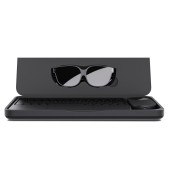
PRODUCTION / REALIZATION TECHNOLOGY: Inair glasses utilize the BirdBath optical solution to deliver high-definition large-screen projection. Ergonomic enhancements, such as flexible composite material temples and directional noise cancellation, improve comfort and privacy. The Pod host innovatively integrates spatial ray and touch interaction, complemented by linear motor feedback for a more natural and intuitive operation. Paired with the spatial touch keyboard, it further enhances the efficiency of spatial interaction. SPECIFICATIONS / TECHNICAL PROPERTIES: Inair Glass: Thickness: 4mm (thinnest) - 20mm (thickest), Weight: 77g;Electrochromic TAGS: INAIR, Spatial Computing, AR Glasses, AI Hardware, Multi-Screen Display, Intelligent Interaction, Productivity, Wearable Device, Ergonomics RESEARCH ABSTRACT: This study explores the application of spatial computing and AI productivity tools in office scenarios, balancing portability with an efficient multi-screen experience while meeting the demands of intelligent work. Through user interviews, usability testing, and data analysis, over 200 professionals were tested in multi-screen collaboration, remote meetings, and AI assistant applications. Findings reveal that screen size impacts work efficiency, large screens and portability are difficult to reconcile, and the potential of AI assistants remains underutilized. Inair leverages BirdBath optical technology for an immersive large-screen experience, integrating spatial ray + touch interaction and AI buttons to enhance workflow and drive the evolution of AI productivity tools. CHALLENGE: The biggest challenge of this project was integrating complex functionalities and numerous components into a sleek, compact, and lightweight design. To enable an efficient multi-screen workspace, the device needed to support high-performance computing, high-definition displays, and intelligent interactions—featu ADDED DATE: 2025-03-10 11:13:46 TEAM MEMBERS (4) : Design Director: Qi Jingxuan, Experience Design: Wang Haoheng, Visual Design: Zhang Tianru and Industrial Design: Xu Changming IMAGE CREDITS: INAIR |
||||
| Visit the following page to learn more: https://www.inairspace.com/ | |||||



| CLIENT/STUDIO/BRAND DETAILS | |
 |
NAME: INAIR PROFILE: INAIR is an AR glasses brand under China Duopingweilai Intelligent Technology Co., Ltd., dedicated to providing consumers with next-generation all-in-one mobile office solutions. The company’s core team consists of members from leading internet and technology enterprises with extensive experience in AR hardware, software, and product design. INAIR has established R&D centers in Beijing, Weihai, and Hong Kong. Founded in 2022, the company holds multiple intellectual property rights, including 10 registered trademarks, 25 patents, and 11 software copyrights. INAIR’s flagship product, INAIR Pro, is an AR glasses designed specifically for mobile business professionals. The device adopts a main unit plus glasses configuration, integrating AI functionalities to expand user scenarios. The INAIR Pro glasses weigh 77g and feature an ergonomic design with a 51-degree ultra-wide field of view and a 225-inch borderless virtual display. It supports up to six simultaneous applications, with a virtual surround screen extending up to 8000×1200 pixels. Additionally, INAIR Pro allows seamless file transfers from mobile devices to the glasses via the INAIR APP, supporting cross-terminal data synchronization, Bluetooth keyboard and mouse connectivity, and direct PC and smartphone integration. In terms of hardware, INAIR Pro is powered by a Qualcomm octa-core processor with 8GB RAM, supports open application installations, and offers the INAIR APP to further enhance the user experience. |

| AWARD DETAILS | |
 |
Inair Ar Spatial Computer by Inair Design Team is Winner in Wearable Technologies Design Category, 2024 - 2025.· Read the interview with designer Inair Design Team for design Inair here.· Press Members: Login or Register to request an exclusive interview with Inair Design Team. · Click here to register inorder to view the profile and other works by Inair Design Team. |
| SOCIAL |
| + Add to Likes / Favorites | Send to My Email | Comment | Testimonials | View Press-Release | Press Kit |
Did you like Inair Design Team's Wearable Technology Design?
You will most likely enjoy other award winning wearable technology design as well.
Click here to view more Award Winning Wearable Technology Design.
  |
 |