
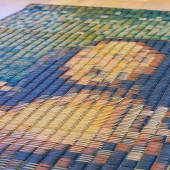
Pixel Weave Monalisa Rug by Hana Mitsui |
Home > Winners > #170574 |
 |
|
||||
| DESIGN DETAILS | |||||
| DESIGN NAME: Pixel Weave Monalisa PRIMARY FUNCTION: Rug INSPIRATION: This work was born out of a deep sense of urgency around the rapid decline of Japan’s Igusa culture. Traditionally used in tatami mats suited to Japan’s humid climate, Igusa grass has seen a dramatic decrease in demand due to modern lifestyle changes, with farms now reduced to just one-twentieth of their peak. To keep this heritage material alive for future generations, I sought to reframe Igusa in a contemporary context bridging traditional craftsmanship with digital aesthetics to explore new, sustainable possibilities for this time-honored material. UNIQUE PROPERTIES / PROJECT DESCRIPTION: Transforming traditional Japanese tatami weaving, I set out to explore new possibilities for Igusa grass. I noticed a compelling visual similarity between the geometric patterns of tatami and the pixel grid of digital imagery. Inspired by this connection, I developed a weaving technique using Igusa grass that captures painterly impressions through pixel-like expressions. By carefully blending the natural hues of Igusa, the image of the world-renowned Mona Lisa emerges—subtle, tactile, and reimagined through a uniquely Japanese material language. The strength of this design lies in its ability to present tatami an everyday, familiar presence in Japanese life from a fresh perspective, refracted through the iconic gaze of the Mona Lisa. It reveals the untapped potential within our daily surroundings, reminding us that even the most ordinary materials can be transformed into something artistic and profound. OPERATION / FLOW / INTERACTION: This piece is an art rug made using traditional Japanese tatami techniques. Though it may look like a digital image, it is handwoven entirely from natural Igusa grass. The portrait of the Mona Lisa appears through pixel-like colored squares—abstract up close, but clear from a distance. It requires no special operation and can be used freely as a floor mat or wall piece. The natural texture and scent blend tradition with contemporary design. PROJECT DURATION AND LOCATION: The project began in Fukuoka, Japan in September 2024 and was completed in December 2024. It was also showcased at a major design event, DESIGNTIDE TOKYO, held in Tokyo in December 2024. |
PRODUCTION / REALIZATION TECHNOLOGY: This piece was produced using the same specialized machines used to weave traditional Japanese Tatami and Goza mats. Japan has unique looms specifically designed for Igusa, and these were essential in bringing this design to life. As the Igusa industry is a small, closed circle, collaborations with designers are rare, making this a new creative challenge for the artisans involved. After choosing the Mona Lisa as the motif, I created a pixelated version and worked closely with the craftspeople to translate it into a weave structure. We exchanged data many times to adjust the pattern, then programmed the loom for production. Since Igusa is resistant to dye, the finished piece was coated to fix the colors. Through many stages, this design was carefully crafted into a new expression of Igusa. SPECIFICATIONS / TECHNICAL PROPERTIES: Dimensions: 1,760 mm (W) × 880 mm (H) × 5 mm (D) TAGS: Weave, Textile, Pixel, Craft, Rug, Art, Mona Lisa, Igusa grass, Tatami RESEARCH ABSTRACT: Colorfully dyed Igusa mats woven with the Kakegawa-ori technique represent a rare and refined tradition, even within Japan. In recent years, however, many younger generations are unaware of the existence of such vibrant tatami, and the craft itself is at risk of fading into obscurity. Having grown up in a home without tatami, I had little familiarity with it. It wasn’t until a work trip to Fukuoka that I encountered Kakegawa-ori in daily use. I was deeply moved by the beauty of this weaving method seamlessly integrated into everyday life, and at the same time, I felt a strong sense of loss and urgency in realizing how this cultural heritage is gradually disappearing. This experience inspired me to launch the project, with the aim of reintroducing the value and beauty of this technique to a wider audience. I selected the Mona Lisa as the central motif because it is an iconic image recognized by virtually everyone, even those with no particular interest in art. It naturally captures attention, and its pixelated form retains a clear visual identity—making it especially well-suited to this method of expression. The work succeeded in drawing attention at the exhibition, encouraging many viewers to engage with this traditional craft from a fresh perspective. CHALLENGE: This project marked my first experience working with Igusa weaving. Since Igusa is typically used for everyday household items, creating a large-scale jacquard weave for an artwork like this is quite rare. Collaborating closely with skilled artisans, I carefully considered the weave structure and color combinations, aiming to achieve maximum expression within the technical limitations of the material. At the same time, I also focused on ensuring the functionality of the piece as a rug, designing the weave with strength and durability in mind. This design is the result of merging my background in textile design with newly acquired knowledge of Igusa—bringing together both experience and experimentation in a truly integrated way. ADDED DATE: 2025-02-27 21:37:49 TEAM MEMBERS (1) : IMAGE CREDITS: [ Image#1,2,3,4 and 5 : Photographer:Naoaki Yokota] PATENTS/COPYRIGHTS: [Copyrights : Hana Mitsui,2025] |
||||
| Visit the following page to learn more: https://hanatextiledesign.com/pixel-weav |
|||||


| CLIENT/STUDIO/BRAND DETAILS | |
 |
NAME: Hana Material Design Laboratory inc. PROFILE: Hana Material Design Laboratory is a research-based initiative led by textile designer Hana Mitsui, working in close collaboration with craftspeople and specialists across Japan. The laboratory is dedicated to the in-depth exploration of distinctive materials and techniques that Mitsui has discovered through her creative practice. Through rigorous research and development, the laboratory produces innovative works that are exhibited in various venues and made available for purchase. By uncovering overlooked or forgotten resources from across Japan, Hana Material Design Laboratory aims to revitalize them with new meaning and relevance for contemporary life. |

| AWARD DETAILS | |
 |
Pixel Weave Monalisa Rug by Hana Mitsui is Winner in Textile, Fabric, Textures, Patterns and Cloth Design Category, 2024 - 2025.· Read the interview with designer Hana Mitsui for design Pixel Weave Monalisa here.· Press Members: Login or Register to request an exclusive interview with Hana Mitsui. · Click here to register inorder to view the profile and other works by Hana Mitsui. |
| SOCIAL |
| + Add to Likes / Favorites | Send to My Email | Comment | Testimonials | View Press-Release | Press Kit |
Did you like Hana Mitsui's Textile Design?
You will most likely enjoy other award winning textile design as well.
Click here to view more Award Winning Textile Design.
  |
 |