Vector Scissors by Tamas Fekete |
Home > Winners > #170558 |
 |
|
||||
| DESIGN DETAILS | |||||
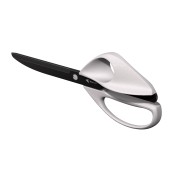
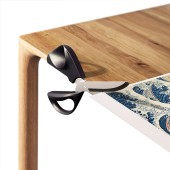
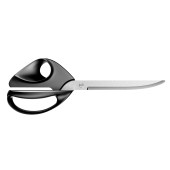
| DESIGN NAME: Vector PRIMARY FUNCTION: Scissors INSPIRATION: The concept emerged from an in-depth exploration of cutting tools, addressing the common challenge of achieving precise, straight cuts with traditional scissors. Inspired by the mechanics of paper guillotines, which use a fixed edge as a guide, the design translates this principle into a handheld tool. Research into various cutting methods and ergonomic studies informed the development, ensuring stability, control, and intuitive use. UNIQUE PROPERTIES / PROJECT DESCRIPTION: Vector Scissors introduce a unique blade and handle design that helps users achieve precise, straight cuts more easily. By pressing the ergonomic handle against the edge of a table, both the blades and the user's hand are stabilized. This allows the user to keep the blades fixed while sliding them forward during cutting. The table edge serves as a natural guide, ensuring a straight and controlled cut with minimal effort. OPERATION / FLOW / INTERACTION: Vector functions like any traditional pair of scissors but offers an additional guided cutting method for improved precision. When used normally, it performs like standard scissors for everyday cutting tasks. For guided straight cuts, users can press the handle against the edge of a table, stabilizing both their hand and the blades. This allows the scissors to slide forward in a straight path, using the table edge as a guide, making precise cuts effortless along the entire length of the table. PROJECT DURATION AND LOCATION: The project started in June 2013 in Budapest and was completed in its initial form in 2014 in Budapest. It was exhibited in the Hungarian Design Award concept category in Budapest (2014) and later showcased at the Semmelweis Museum the same year. From 2016 to 2017, it was part of the Shaping Hungary - Design in the 21st Century exhibition across various locations in Europe. The latest design update started in 2024 in Rotterdam, and was completed in January 2025 in Rotterdam. |
PRODUCTION / REALIZATION TECHNOLOGY: The development involved multiple physical prototype iterations, including 3D-printed prototypes and clay-sculpted ergonomic handle models. The handle was sculpted and refined by hand, then laser-scanned and reverse-engineered for digital replication. Early production used silicone-molded resin-cast handles with surface treatments for durability, while the latest generation is produced using additive manufacturing, with the option to expand to injection molding as well. The stainless steel blades are precision laser-cut, hardened, and hand-sharpened by a third-generation scissors craftsman in Hungary. SPECIFICATIONS / TECHNICAL PROPERTIES: Product Dimensions: Width: 225mm x Depth: 40mm x Height: 90mm TAGS: scissors, precision cutting, ergonomic handle, straight-cut scissors, guided cutting, innovative cutting tool, paper cutting, crafting scissors, fabric cutting, blade design RESEARCH ABSTRACT: The research aimed to enhance scissor precision while preserving the versatility of traditional designs. Through user interviews and focus groups, several common challenges were identified, most notably the difficulty of cutting straight lines accurately. Users frequently expressed frustration at the lack of tools that allow for precise, straight cuts without needing a ruler or external guide. Many described the process of cutting straight lines freehand using scissors are difficult and time-consuming, especially for repetitive tasks. To address these pain points, various blade-handle orientations and ergonomic configurations were tested to develop a solution that not only improves straight-cutting performance but also ensures comfort and ease of use. The result is a design that bridges the gap between everyday functionality and guided precision cutting. CHALLENGE: One of the biggest challenges was determining the optimal handle and blade orientation to enable precise straight-line cutting. This required extensive trial and error, with multiple design iterations to refine the right orientation of the blade and the handle. Achieving a balance between functionality and ergonomics was critical, as the form had to strictly follow both. The process involved continuous testing and adjustments to ensure intuitive usability while maintaining the versatility of traditional scissors. ADDED DATE: 2025-02-27 20:18:59 TEAM MEMBERS (1) : IMAGE CREDITS: Image #1: 3D Rendering Tamás Fekete, Vector Scissors 1, 2025 Image #2: 3D Rendering Tamás Fekete, Vector Scissors 2, 2025 Image #3: 3D Rendering Tamás Fekete, Vector Scissors 3, 2025 Image #4: 3D Rendering Tamás Fekete, Vector Scissors 4, 2025 Image #5: 3D Rendering Tamás Fekete, Vector Scissors 5, 2025 PATENTS/COPYRIGHTS: Patented. Utility Model No. 4872. Tamás Fekete. 2013. Budapest, Hungary. Copyrights belongs to Tamás Fekete, 2013–2025. |
||||
| Visit the following page to learn more: https://bit.ly/Vector-Scissors | |||||

| CLIENT/STUDIO/BRAND DETAILS | |
 |
NAME: Openend Design Ltd. PROFILE: Openend Design specialises in innovative industrial design and product development, delivering cutting-edge solutions that blend creativity, functionality, and aesthetics. With expertise in consumer goods, soft goods, and high-quality product visualisation, the studio transforms ideas into market-ready products through a streamlined process from concept to production, including rapid prototyping and manufacturing support. |

| AWARD DETAILS | |
 |
Vector Scissors by Tamas Fekete is Winner in Art and Stationery Supplies Design Category, 2024 - 2025.· Read the interview with designer Tamas Fekete for design Vector here.· Press Members: Login or Register to request an exclusive interview with Tamas Fekete. · Click here to register inorder to view the profile and other works by Tamas Fekete. |
| SOCIAL |
| + Add to Likes / Favorites | Send to My Email | Comment | Testimonials | View Press-Release | Press Kit |
Did you like Tamas Fekete's Art Supplies Design?
You will most likely enjoy other award winning art supplies design as well.
Click here to view more Award Winning Art Supplies Design.
  |
 |