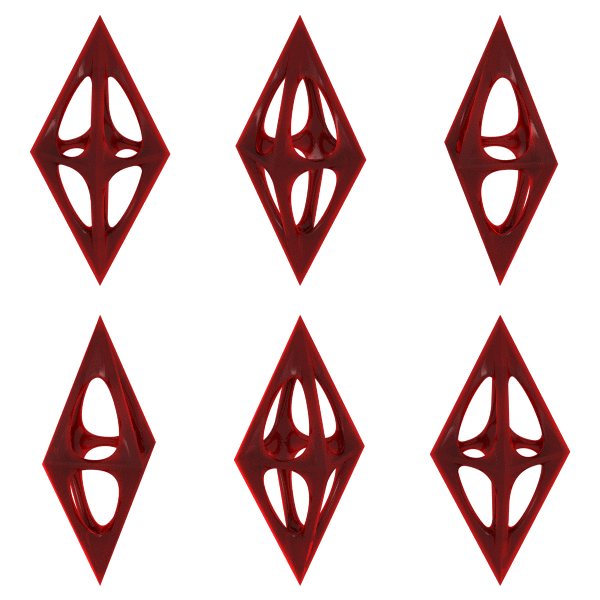
Meta Keysmith Metaverse Space by Guanyu Tao |
Home > Winners > #169693 |
 |
|
||||
| DESIGN DETAILS | |||||
| DESIGN NAME: Meta Keysmith PRIMARY FUNCTION: Metaverse Space INSPIRATION: Meta Keysmith is inspired by the importance of thresholds in architecture. In physical spaces, entry is more than a passage—it is a designed transition that enhances experience. However, metaverse access is often abrupt, lacking spatial depth. This project restores the ritual of entry, creating a structured transition that makes stepping into the virtual world an intentional act, rather than just a teleportation or loading screen. UNIQUE PROPERTIES / PROJECT DESCRIPTION: Meta Keysmith is a metaverse-oriented spatial design that introduces a framework for 3D password authentication. Instead of conventional alphanumeric inputs, it employs spatial puzzles with randomized configurations, requiring users to interact with the environment to unlock entry. Developed using point cloud scanning, VR prototyping, and Unreal Engine, this system enhances security and immersion, transforming access into a structured, interactive spatial experience. OPERATION / FLOW / INTERACTION: Meta Keysmith transforms the login process into an interactive spatial journey. Instead of typing a password, users navigate through a 3D puzzle, where movement and interaction unlock access. The space dynamically adapts, generating randomized paths for each entry. This process makes access more engaging, secure, and immersive, replacing the passive login screen with an interactive transition that enhances user presence in the metaverse. PROJECT DURATION AND LOCATION: This is a virtual project completed in 2022. As a digital architectural concept, META_KEYSMITH exists within virtual environments rather than a physical location. The project was developed as an exploration of spatial interaction and metaverse entry design, focusing on how architecture can redefine digital thresholds and user experiences in virtual worlds. |
PRODUCTION / REALIZATION TECHNOLOGY: Meta Keysmith is developed using procedural modeling and parametric design with Blender, Cinema 4D, and Houdini. The project integrates VR and Unreal Engine as the game engine, allowing users to interact with the space through controllers. By engaging in spatial interaction, players input their access keys, making the transition into the metaverse an interactive and immersive entry process rather than a passive login. SPECIFICATIONS / TECHNICAL PROPERTIES: As a digital architecture prototype, the demo space of Meta Keysmith measures approximately 10m x 20m. It consists of a layered transition zone where users interact with spatial puzzles to gain access. The design is modular and scalable, allowing integration into various metaverse platforms. Its technical framework supports real-time interaction, VR compatibility, and adaptive spatial configurations for a seamless and immersive entry experience. TAGS: metaverse, architecture, space design, virtual reality, interactive entry, digital threshold, procedural design, immersive experience, spatial transition, 3D puzzle RESEARCH ABSTRACT: This research explores spatial entry design in the metaverse, focusing on how architecture can create immersive and meaningful transitions. The objective was to develop a 3D interaction-based access system instead of traditional login methods. The methodology included point cloud scanning of real-world spaces, VR-based prototyping in Unreal Engine, and spatial typology studies on temples and Japanese architecture. The findings show that structured spatial transitions enhance user orientation and engagement, offering new perspectives on digital thresholds in virtual environments. This research impacts metaverse design, security, and user experience, influencing how virtual spaces are perceived and navigated. CHALLENGE: The biggest challenge was translating architectural entry principles into a virtual context where traditional constraints do not apply. Unlike physical spaces, metaverse environments lack material limitations, requiring a new logic for spatial transitions. Another challenge was designing a secure yet engaging password system using 3D puzzles instead of text. Overcoming these required procedural design, VR integration, and adaptive interactions to ensure usability and immersion. ADDED DATE: 2025-02-25 02:12:28 TEAM MEMBERS (1) : IMAGE CREDITS: Image #1: Designer Guanyu Tao Image #2: Designer Guanyu Tao Image #3: Designer Guanyu Tao Image #4: Designer Guanyu Tao Image #5: Designer Guanyu Tao |
||||


| CLIENT/STUDIO/BRAND DETAILS | |
 |
NAME: Gerry Tao PROFILE: Gerry Tao is an architectural design collection that includes the in-house architectural works and related art pieces of Guanyu Tao from small architecture design to urban planning initiatives in Guanyu Tao’s professional journey. |

| AWARD DETAILS | |
 |
Meta Keysmith Metaverse Space by Guanyu Tao is Winner in Interface, Interaction and User Experience Design Category, 2024 - 2025.· Read the interview with designer Guanyu Tao for design Meta Keysmith here.· Press Members: Login or Register to request an exclusive interview with Guanyu Tao. · Click here to register inorder to view the profile and other works by Guanyu Tao. |
| SOCIAL |
| + Add to Likes / Favorites | Send to My Email | Comment | Testimonials | View Press-Release | Press Kit |
Did you like Guanyu Tao's Interface Design?
You will most likely enjoy other award winning interface design as well.
Click here to view more Award Winning Interface Design.
  |
 |