Dash Pendant Light by Seyed Shahriyar Shahriyari |
Home > Winners > #169147 |
 |
|
||||
| DESIGN DETAILS | |||||
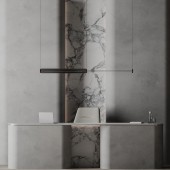
| DESIGN NAME: Dash PRIMARY FUNCTION: Pendant Light INSPIRATION: Inspired by aerospace engineering, this pendant light reflects the efficiency and elegance of airplane wings. Its ultra-thin structure mirrors the aerodynamic precision of aviation, optimizing strength while maintaining a sleek profile. Like aircraft design, it uses lightweight yet durable materials, ensuring structural integrity without bulk. The seamless modular connection and rotational flexibility echo the adaptability of wing flaps. UNIQUE PROPERTIES / PROJECT DESCRIPTION: This ultra-slim 8mm pendant light blends innovation with versatility. Its modular units connect seamlessly via a cylindrical joint, allowing each module to rotate 60 degrees independently. The body itself functions as both reflector and shader, eliminating the need for lenses to control the beam angle. This optical innovation enhances efficiency and visual comfort, while precision engineering ensures durability and seamless adaptability for various spaces. OPERATION / FLOW / INTERACTION: The luminaire has a tilt capability of up to 60 degrees from its fixture, and each module can be adjusted to a unique angle. It also features touch-free control with proximity-based dimming and can be extended with an infinite number of modules. The adjustable angle, which can be modified manually, offers users a variety of lighting solutions tailored to their requirements. PROJECT DURATION AND LOCATION: Conceived in July 2024, this innovative lighting concept was developed over six months and produced in Vienna, Austria, by January 2025. FITS BEST INTO CATEGORY: Lighting Products and Fixtures Design |
PRODUCTION / REALIZATION TECHNOLOGY: This pendant light was crafted through precision engineering, using high-quality aluminum for its ultra-slim body to ensure durability and heat dissipation. Advanced CNC machining and extrusion techniques enable seamless modularity and precision. SPECIFICATIONS / TECHNICAL PROPERTIES: Width 200 mm, thickness 8 mm, length 800 mm. TAGS: Lighting, pendant, modular, minimal, slim, aluminum, led, modern, architectural, decorative, brass RESEARCH ABSTRACT: The development of an ultra-slim, modular pendant lighting system addresses key contemporary needs in architectural and interior design. With a thickness of just 8mm, this fixture offers a sleek and unobtrusive profile, optimizing space while delivering efficient illumination. Its modular structure includes individual units measuring 80 by 20 centimeters, designed to rotate up to 60 degrees. This flexibility allows designers to create customized lighting arrangements suited to different spatial layouts and aesthetic preferences. To enhance visual comfort, the fixture’s body functions as both a reflector and a shader, eliminating the need for additional lenses. This design effectively controls beam angles, minimizes glare, and reduces eye strain. Inspired by the aerodynamic form of airplane wings, the lighting system blends functionality with a modern, minimalist aesthetic, appealing to both designers and end-users. Advancements in materials and manufacturing techniques have made this innovative design feasible. High-strength, lightweight aluminum ensures durability without adding bulk, while precision fabrication methods such as CNC machining and extrusion enable the creation of ultra-thin profiles with integrated rotational joints, ensuring both form and function. As the demand for customizable, space-efficient, and visually comfortable lighting solutions continues to grow, this approach presents a highly relevant and forward-thinking solution for contemporary design. CHALLENGE: Developing this ultra-slim, modular pendant lighting system presented challenges in integrating technical components within an 8mm-thick fixture. This required miniaturized drivers, LEDs, and optimized layouts for heat dissipation. Designing adjustable, load-bearing joints for the modular system needed high-strength materials and precise mechanical interfaces. The optical design also had to achieve the correct beam angle without traditional lenses, using the fixture’s body as both a reflector and a shader for optimal light distribution. ADDED DATE: 2025-02-21 12:31:55 TEAM MEMBERS (1) : IMAGE CREDITS: Seyed Shahriyar Shahriyari, 2024. |
||||
| Visit the following page to learn more: https://www.triolicht.com/product/dash/ | |||||

| CLIENT/STUDIO/BRAND DETAILS | |
 |
NAME: TRIO LICHT PROFILE: Trio Licht, a Vienna-based lighting company, adopts an architectural approach to lighting design, emphasizing innovation and creativity. With a focus on modularity and pattern design, Trio Licht offers a unique designer category line that showcases the collaboration between architectural principles and lighting solutions. The company's dedication to pushing the boundaries of lighting design has earned them recognition in the industry. By combining form and function, Trio Licht successfully addresses the diverse needs of clients while providing visually captivating and highly efficient lighting options. |

| AWARD DETAILS | |
 |
Dash Pendant Light by Seyed Shahriyar Shahriyari is Winner in Lighting Products and Fixtures Design Category, 2024 - 2025.· Read the interview with designer Seyed Shahriyar Shahriyari for design Dash here.· Press Members: Login or Register to request an exclusive interview with Seyed Shahriyar Shahriyari. · Click here to register inorder to view the profile and other works by Seyed Shahriyar Shahriyari. |
| SOCIAL |
| + Add to Likes / Favorites | Send to My Email | Comment | Testimonials | View Press-Release | Press Kit |
Did you like Seyed Shahriyar Shahriyari's Lighting Design?
You will most likely enjoy other award winning lighting design as well.
Click here to view more Award Winning Lighting Design.
  |
 |