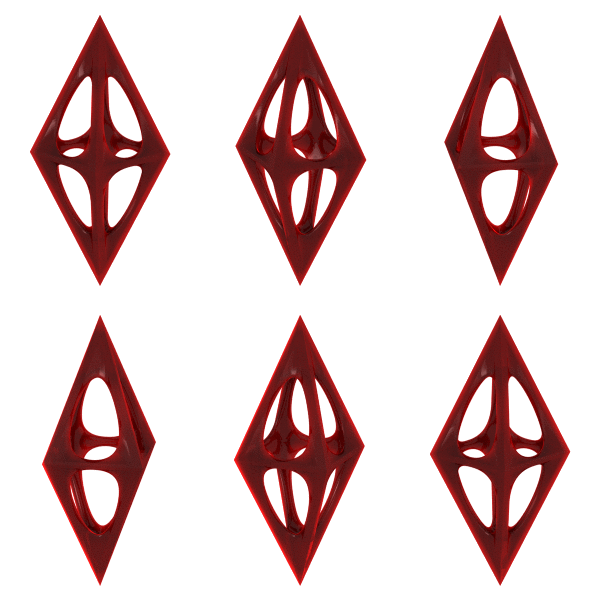
Lumenica Lighting Collection by Vergunovs and Maria Kolesnikova |
Home > Winners > #168502 |
 |
|
||||
| DESIGN DETAILS | |||||
| DESIGN NAME: Lumenica PRIMARY FUNCTION: Lighting Collection INSPIRATION: The Lumenica collection is inspired by the organic aesthetics of nature. The idea was to convey their flowing, airy forms through glass, emphasizing the play of light and the sense of movement. The study of biomorphic structures and glass processing techniques made it possible to create a relief with a twisting effect that gives the luminaires dynamics. This project combines craft tradition, experimentation with material and natural harmony in design. UNIQUE PROPERTIES / PROJECT DESCRIPTION: The Lumenica lighting collection is inspired by the bionic forms of nature - flowers, mushrooms and jellyfish. Its uniqueness lies in the combination of refined glass with dynamic reliefs that create the effect of movement. The use of frosted, transparent and colored glass emphasizes natural imagery, while twisted relief glass gives the luminaires a lively, organic plasticity. Lumenica combines the aesthetics of nature and innovative design. OPERATION / FLOW / INTERACTION: Standard switching of luminaires. PROJECT DURATION AND LOCATION: The Lumenica luminaire collection was developed as part of a training program in which it was necessary to create a luminaire(or a collection of luminaires) on the theme of any concept. The focus was on bionic forms of nature. Work on the collection began in September 2024 and was completed in the winter of December 2024. The collection was presented at the University's artwork viewing in December 2024, where it was shown to other students and faculty. FITS BEST INTO CATEGORY: Lighting Products and Fixtures Design |
PRODUCTION / REALIZATION TECHNOLOGY: Lumenica collection luminaires are made of glass, combining frosted, transparent and colored elements. The key technology is the twisting of relief glass, creating a dynamic optical effect. The glass is hand-blown, then molded and textured. The color scheme enhances biomorphic associations, emphasizing natural forms. The methods used ensure high quality, the uniqueness of each piece and the harmony of light with the material. SPECIFICATIONS / TECHNICAL PROPERTIES: The Lumenica collection includes fixtures in the following sizes: table lamp 1 - 115 mm (w) × 246 mm (h) × 160 mm (d), wall lamp - 126 mm (w) × 340 mm (h) × 176 mm (d), table lamp 2 - 115 mm (w) × 442 mm (h) × 183 mm (d), pendant lamp - 128 mm (w) × 346 mm (h) × 196 mm (d). TAGS: Lamps, bionics, glass, luminaires, nature, relief glass, modern design, dynamics, organic forms. RESEARCH ABSTRACT: The research for the Lumenica project focused on the study of bionic forms in nature and their adaptation in lighting design. The goal was to create luminaires that convey an organic aesthetic through material and lighting effects. The methodology included analysis of natural structures, sketching, 3D modeling, and experiments with glass shaping. The work explored glass properties, transparency, texture and processing techniques. Experiments were conducted with relief twisting of glass to create a dynamic visual effect. Participants in the process included faculty, mentors, and students whose feedback helped refine the concept. The result was a collection of luminaires that combined the aesthetics of nature and modern glass processing techniques. The research showed that bionic forms can not only inspire design, but also enhance the perception of light in a space. This approach can be in demand in interior and industrial design, creating harmonious and functional lighting objects. CHALLENGE: The most challenging part of Lumenica's design work was overcoming technological and creative obstacles. The creative challenge was to organically adapt the bionic forms into a functional luminaire design. Challenges arose during the glass processing phase: twisting and texturizing techniques had to be developed, which required careful refinement of techniques and experimentation. Internal factors included a lack of experience with certain materials and techniques, and the need to consider aesthetic and functional aspects of the design. External factors, such as the availability of information on glass technology and limitations in production capabilities, also influenced the process. The historical perspective and social context, taking into account current trends in design and sustainability, required careful attention to the selection of materials and methods. By overcoming these challenges, it has been possible to create unique and harmonious luminaires that meet today's design and environmental requirements. ADDED DATE: 2025-02-14 13:47:03 TEAM MEMBERS (2) : Sergey Vergunov and Maria Kolesnikova IMAGE CREDITS: Vergunovs and Maria Kolesnikova, 2024. |
||||


| CLIENT/STUDIO/BRAND DETAILS | |
 |
NAME: O.M. Beketov National University of Urban Economy in Kharkiv PROFILE: It is a unique higher educational establishment in the field of training highly-skilled professionals for housing and municipal economy, municipal management, construction, transport, electricity-, water-, gas-, and heat supply, lighting sphere, tourist and hotel industry, ecological and technological safety. University has specialized academic councils to award Doctor's degree and PhD operate in the University. |

| AWARD DETAILS | |
 |
Lumenica Lighting Collection by Vergunovs and Maria Kolesnikova is Winner in Lighting Products and Fixtures Design Category, 2024 - 2025.· Read the interview with designer Vergunovs and Maria Kolesnikova for design Lumenica here.· Press Members: Login or Register to request an exclusive interview with Vergunovs and Maria Kolesnikova. · Click here to register inorder to view the profile and other works by Vergunovs and Maria Kolesnikova. |
| SOCIAL |
| + Add to Likes / Favorites | Send to My Email | Comment | Testimonials | View Press-Release | Press Kit |
Did you like Vergunovs and Maria Kolesnikova's Lighting Design?
You will most likely enjoy other award winning lighting design as well.
Click here to view more Award Winning Lighting Design.
  |
 |