
Ayla Bag by Liam Huff |
Home > Winners > #167955 |
 |
|
||||
| DESIGN DETAILS | |||||
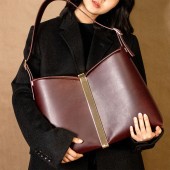
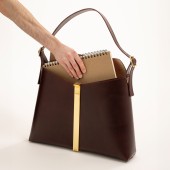
| DESIGN NAME: Ayla PRIMARY FUNCTION: Bag INSPIRATION: Leather is one of the most polluting sectors within fashion. Most leather products contribute to the idea of take-make-waste. Reducing environmental impact is not as simple as switching to a leather alternative. Almost all alternatives are polymer based and cannot match traditional leather's longevity. If farmed regeneratively, used as meat industry byproduct, and, if able to be used multiple times, leather can be sustainable. Ayla explores how we can use leather to its maximum potential. UNIQUE PROPERTIES / PROJECT DESCRIPTION: Modular and transformable leather panels along with detachable hinges allow Ayla to last multiple product life cycles. The detachable hinge facilitates ease of repair when the product gets damaged. Simply undo the hinge and replace the damaged leather panel, eliminating the need to throw away the entire product. The ability to fully disassemble the product allows for an environmentally friendly end-of-life with the ability to either repair or transform old leather panels into new products. OPERATION / FLOW / INTERACTION: The detachable nature of the metal hinge allows for components within the product to be interchanged when damage occurs. If one side of the product gets damaged, simply replace that panel, not the entire item; this reduces wastage. Additionally, the main leather panels were designed to be turned into a different, smaller product if only one panel can be salvaged. Predetermined patterns ensure that one panel can be turned into a smaller clutch, further reducing the waste of the item. PROJECT DURATION AND LOCATION: Started in August of 2023 at Rochester Institute of Technology in Rochester, New York, USA. and finished in May of 2024 in Rochester, New York, USA. |
PRODUCTION / REALIZATION TECHNOLOGY: Experimenting with multiple 3D printed components, I focused on exploring ways to attach leather panels without the use of stitching. I landed on a pin system. Leather panels are sandwiched between an outer hinge and an inner plate. The panels are secured atop the pins and then anchored with a series of screws. With these hinges, everything from the handle, to the main body, to the interior can be replaced. Final hinges were made of polished brass to ensure longevity with extended ware. SPECIFICATIONS / TECHNICAL PROPERTIES: 460 mm x 100 mm x 330 mm TAGS: Bag, Leather, Sustainable, Hardware, Interchangeable, Replaceable, Tote, Modular Panels, Transformable RESEARCH ABSTRACT: I started with database research to determine opportunities to reduce waste. I interviewed 4 professionals in the fashion accessories industry. I used these two methods to inform my hinge mechanism. For product look and feel, I used a survey to determine bag silhouette, mood boards to determine detail and target audience, triading to determine desired look, narrative scenarios to determine how the bag would be used, and user interviews to ultimately hone in on a final design direction. CHALLENGE: The hardest part of this project was finding the perfect intersection of functionality/sustai ADDED DATE: 2025-02-05 22:27:39 TEAM MEMBERS (1) : IMAGE CREDITS: Image #1 : Photographer Elizabeth Lemark, AYLA_1_3600.jpg, 2024. Image #2 : Photographer Chelsea Cohen, AYLA_MAIN_1800.jpg, 2024. Image #3 : Photographer Chelsea Cohen, AYLA_2.jpg, 2024. Image #4 : Photographer Elizabeth Lemark, AYLA_3.jpg, 2024. Image #5 : Photographer, Sneha Yalgi, AYLA_5.jpg, 2024 |
||||
| Visit the following page to learn more: https://scotthuff.com/ayla | |||||


| CLIENT/STUDIO/BRAND DETAILS | |
 |
NAME: Rochester Institute of Technology PROFILE: RIT offers a dynamic, interdisciplinary education that empowers students to innovate and lead at the intersection of technology, the arts, and design across our 11 diverse colleges and degree-granting units. With flexible academic pathways including Combined Accelerated Bachelor’s/Master’s Degree, double majors, and specialized minors and immersions, students can tailor their education to meet their unique interests and career goals. Graduates join a global alumni network of 155,000, including CEOs, innovators, and Academy Award winners. |

| AWARD DETAILS | |
 |
Ayla Bag by Liam Huff is Winner in Fashion and Travel Accessories Design Category, 2024 - 2025.· Read the interview with designer Liam Huff for design Ayla here.· Press Members: Login or Register to request an exclusive interview with Liam Huff. · Click here to register inorder to view the profile and other works by Liam Huff. |
| SOCIAL |
| + Add to Likes / Favorites | Send to My Email | Comment | Testimonials | View Press-Release | Press Kit |
Did you like Liam Huff's Accessory Design?
You will most likely enjoy other award winning accessory design as well.
Click here to view more Award Winning Accessory Design.
  |
 |