Color Roller Furniture Set by Chuheng He |
Home > Winners > #167382 |
 |
|
||||
| DESIGN DETAILS | |||||
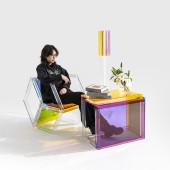
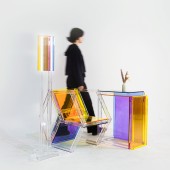
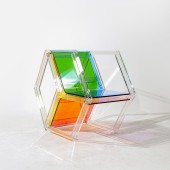
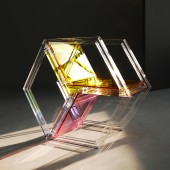
| DESIGN NAME: Color Roller PRIMARY FUNCTION: Furniture Set INSPIRATION: Like De Stijl deconstructed space with three simple colors, Color Roller uses these colors flexibly to reconstruct the world. Red, yellow, and blue, when made transparent, create more colors through layering. Color Roller is an experiment with color, exploring the geometric properties of shapes and volumes. The three components use different structures, with acrylic panels intersecting in pairs, linking basic forms and colors through construction. UNIQUE PROPERTIES / PROJECT DESCRIPTION: Color Roller is a furniture set that changes color combinations through rolling, using basic shapes and colors to create a unique spatial experience. Made from transparent acrylic, it displays varied colors under different lighting. Three acrylic panels intersect and overlap to form a vibrant palette. Minimally, the set features a hexagonal chair, rectangular table and triangular floor lamp. Users can flip and rearrange the pieces to personalize their space with dynamic color combinations. OPERATION / FLOW / INTERACTION: Color Roller can change its color composition through rolling, allowing users to freely flip and rearrange the pieces to decorate the interior space and create a personalized creative atmosphere. PROJECT DURATION AND LOCATION: The project started in March 2024 in Shanghai and finished in October 2024 in Shanghai. FITS BEST INTO CATEGORY: Furniture Design |
PRODUCTION / REALIZATION TECHNOLOGY: Colored acrylic thermoforming and adhesive bonding. SPECIFICATIONS / TECHNICAL PROPERTIES: Chair: 892 mm x 540 mm x 892 mm Table: 750 mm x 600 mm x 450 mm Lamp: 328 mm x 328 mm x 1440 mm TAGS: Acrylic, Color, Hexagon, Geometry, Roller, Rolling, Combination RESEARCH ABSTRACT: The design research started with studying how three panels overlap in different ways. The 1:5 scale models were created to test lighting effects, leading to three basic geometric structures. The 1:1 prototypes were made with different materials and connections, especially for the hexagonal chair, which needs to support human weight. Aluminum, wood, and acrylic frames were tested, with acrylic varying in thickness and solidity. The lightest structure was selected after weight-bearing tests. CHALLENGE: The first prototype of the acrylic chair was very sturdy, able to support human weight. However, the solid acrylic frame was too bulky, losing its intended light and free appearance, and the thick colored panels increased costs. So, I began simplifying the design, optimizing the structure to use minimal materials and adhesive, while maintaining the load-bearing capacity. ADDED DATE: 2025-01-20 13:09:07 TEAM MEMBERS (1) : Chuheng He IMAGE CREDITS: Chuheng He, 2024. |
||||
| CLIENT/STUDIO/BRAND DETAILS | |
 |
NAME: He Chuheng PROFILE: He Chuheng is a young Chinese designer, adept at utilizing geometric forms as a design language for creation. His design philosophy is to be interesting, ingenious, and inspiring. |

| AWARD DETAILS | |
 |
Color Roller Furniture Set by Chuheng He is Winner in Furniture Design Category, 2024 - 2025.· Read the interview with designer Chuheng He for design Color Roller here.· Press Members: Login or Register to request an exclusive interview with Chuheng He. · Click here to register inorder to view the profile and other works by Chuheng He. |
| SOCIAL |
| + Add to Likes / Favorites | Send to My Email | Comment | Testimonials | View Press-Release | Press Kit |
Did you like Chuheng He's Furniture Design?
You will most likely enjoy other award winning furniture design as well.
Click here to view more Award Winning Furniture Design.
  |
 |