
Ferrying Compound Bookstore by Xixi Quan and Kau Chan |
Home > Winners > #163085 |
 |
|
||||
| DESIGN DETAILS | |||||
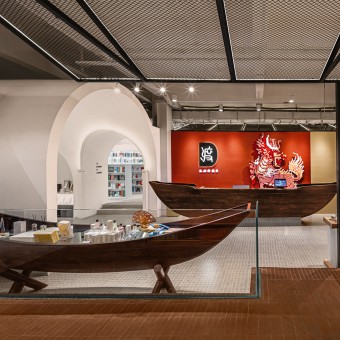
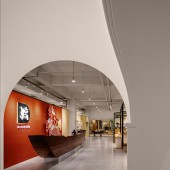
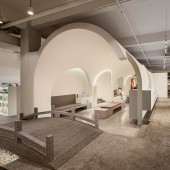
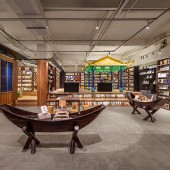
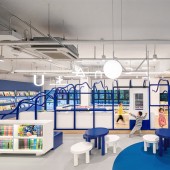
| DESIGN NAME: Ferrying PRIMARY FUNCTION: Compound Bookstore INSPIRATION: The project intends to create a literary living room full of a sense of belonging for Nansha residents and children. Nansha's traditional villages were built in the Pearl River system in southern China. Boats were an important means of transportation, and Western artillery and Western buildings from hundreds of years ago are still standing. The ancient village believed that the Qilin was an auspicious beast, and contemporary residents have inherited the Qilin dance of their ancestors. UNIQUE PROPERTIES / PROJECT DESCRIPTION: An abstract local traditional water town block is used as the logic of spatial organization: the river connects the space of books, commodities and salon, including small bridges, village houses, miniature squares, Chinese octagonal pavilions, ferries and mythical beasts "Qilin". They are also connected with contemporary technological elements such as local subway trains, AR experience and modern tea. The contrast between ancient and modern times makes this bookstore full of interest and attraction. OPERATION / FLOW / INTERACTION: This "water town market" is a fusion of ancient and modern, East and West. It not only provides reading, learning, work space, tea, coffee, light meals, AR experience, workshops, but also full of imagination and scene experience, like: there are houses on both sides of the "river", which contain books, various interesting products and cultural and art salons. The wooden boat booth seems to be sailing in the river, making the space dynamic. At the end of the "river" is the salon area. The steps, octagonal pavilions, wooden boats, houses and sloping roofs create a gathering atmosphere of a small village square, welcoming people to sit down and read and talk, meet new friends and have new stories. The children's area is themed on the subway station. The body of the train is composed of undulating steel structure lines, and the space is full of rhythm. Children like abstract shapes and lines. They drill and climb in the lines, hang and shake on the lines. Children also like to push and pull the doors of subway train. They open and close doors and play hide-and-seek by themselves, and they prefer to be a train driver driving in front. When children play and read, parents can enjoy coffee and tea and aesthetic space or work next to them. PROJECT DURATION AND LOCATION: The project is located in Huangge Town, Nansha Economic Development Zone, Guangzhou, China. Construction began in November 2022 and opened in April 2023. It has become a well-deserved "literary living room" in the hearts of community residents, a leisure and comfortable ocean of knowledge, and an elegant aesthetic space. FITS BEST INTO CATEGORY: Interior Space and Exhibition Design |
PRODUCTION / REALIZATION TECHNOLOGY: This is a public welfare space. With a low construction budget, the ceiling is exposed and the local traditional simple floor materials are used: cement self-leveling, terrazzo, clay bricks, granite, etc. All the houses and their sloping roofs, octagonal pavilions, and subway trains are composed of simple steel structure lines, and the rhythmic subway train lines are parametrically generated using Grasshopper. The steel structure and the metal keel of the fort style white arch book corridor are prefabricated in the factory, which can also save costs. The mortise and tenon structure of the octagonal pavilion is relatively complex, and delicate indirect lighting is also set up to express the coexistence of its traditional structure and contemporary lighting aesthetics. The pixelated Qilin mythical beast is assembled with wooden modules, and the wooden boat display stand is specially customized in the wooden boat factory to ensure the creation of a local aesthetic atmosphere. SPECIFICATIONS / TECHNICAL PROPERTIES: 1500 square meters, two floors TAGS: multifunctional bookstore, literary living room, local water village aesthetics, mix and match of Eastern and Western styles, factory prefabrication, parametric technology, Traditional handmade wooden boat RESEARCH ABSTRACT: How to define a composite bookstore? How can we make it a highly utilized community “literary living room”? How should its functional settings, product and book category selection, and spatial aesthetic form be established? How to make residents feel a sense of belonging in this space? The design team conducted field surveys among residents of Nansha community, used MAXQDA to analyze qualitative data, and conducted qualitative research data collection, and came to the following conclusions: 1. Residents have a strong interest in continuing the traditional cultural context. 2. The demand for a relaxed composite parent-child space is very high: it allows children to read, socialize and play games, and allows parents to socialize, work and enjoy life. 3. The need for small local aesthetic spaces for gathering: as a supplement to libraries and community centers, this space should be full of friendly memories, rich in artistic atmosphere, elegant and relaxed, so that residents can hold events here Literature, art salons, and workshops can greatly improve the quality and taste of community life, help residents discover their inner strength, and give them the opportunity to discover a new self. 4. Non-standard new micro-integrated commercial entities should, in addition to the above-mentioned parts, provide products or brands that are different from ordinary products or brands on the market, such as distinctive handmade products and exquisite life aesthetic products that are close to life needs. Or niche brands. 5. The book categories should be mainly literature, popular science, psychology, art and life, children and youth books. CHALLENGE: The traditional octagonal pavilion in the salon space needs to present a contemporary sense of form to coordinate with the modern atmosphere of the community. Therefore, the simplified logic, color matching, lighting methods, and nodes of the traditional structure should be unique and original. Therefore, the design and construction process is challenging and needs to balance the relationship between the cost budget and the workers' wages. During the construction process, the octagonal pavilion must be completed on site with the workers to save budget and time. The parametric body steel structure lines of the children's area should form changing parameters according to the movements of children of different ages and their corresponding data. The challenge of this design process is that the scale data needs to be very fine to ensure that the rhythmic lines can accommodate the body movements of children of different ages without getting them stuck. ADDED DATE: 2024-06-30 12:31:04 TEAM MEMBERS (1) : Xixi Quan, Kau Chan and Junming Chen IMAGE CREDITS: Xixi Quan and Kau Chan, 2024. |
||||
| CLIENT/STUDIO/BRAND DETAILS | |
 |
NAME: MUST Design Digital Construction Laboratory PROFILE: MUST Design Digital Construction Laboratory belongs to Macau University of Science and Technology (MUST). MUST Design Digital Construction Laboratory was established in 2017. Adhering to universities' and colleges' scientific and humanistic spirit, it explores the application of parametric design and related materials and construction technologies. Research innovative metal hybrid printing manufacturing, complex structure manufacturing, automated manufacturing, and other technologies and hybrid technologies. Optimize the design through deep learning algorithms and parametric design technologies and constantly explore the creative applications of related technologies in the construction of buildings and indoor and outdoor environments. |

| AWARD DETAILS | |
 |
Ferrying Compound Bookstore by Xixi Quan and Kau Chan is Winner in Interior Space and Exhibition Design Category, 2024 - 2025.· Read the interview with designer Xixi Quan and Kau Chan for design Ferrying here.· Press Members: Login or Register to request an exclusive interview with Xixi Quan and Kau Chan. · Click here to register inorder to view the profile and other works by Xixi Quan and Kau Chan. |
| SOCIAL |
| + Add to Likes / Favorites | Send to My Email | Comment | Testimonials | View Press-Release | Press Kit |
Did you like Xixi Quan and Kau Chan's Interior Design?
You will most likely enjoy other award winning interior design as well.
Click here to view more Award Winning Interior Design.
  |
 |