
Living in Motion Apartment by YingYing Chen |
Home > Winners > #162965 |
 |
|
||||
| DESIGN DETAILS | |||||
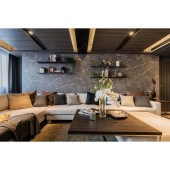
| DESIGN NAME: Living in Motion PRIMARY FUNCTION: Apartment INSPIRATION: A home should adapt and breathe with its inhabitants. Inspired by fluid living, this design draws from Eastern aesthetics, using lattice structures and layered materials to express rhythm and spatial continuity. Light and material transitions reflect shifts in perception, forming a dynamic yet serene space that offers both openness and retreat. UNIQUE PROPERTIES / PROJECT DESCRIPTION: This design redefines residential space through flexibility, layering, and adaptability. Unlike traditional layouts, it replaces fixed partitions with 360-degree rotating lattice doors and concealed sliding panels, allowing seamless transitions between openness and privacy. The integration of Eastern lattice motifs, reflective surfaces, and dynamic lighting enhances depth and spatial fluidity. A focus on sustainability through low-carbon materials and modular elements further sets it apart. OPERATION / FLOW / INTERACTION: Morning light filters through lattice patterns, casting dynamic shadows. The 360° pivot doors shift boundaries as residents move through the space. A concealed bar transforms into a social hub. By evening, warm tones and a smart lighting system create a soft ambiance, guiding seamless transitions between activity and rest. PROJECT DURATION AND LOCATION: The project commenced in January 2024 in Taipei, Taiwan, and was completed in August 2024. FITS BEST INTO CATEGORY: Interior Space and Exhibition Design |
PRODUCTION / REALIZATION TECHNOLOGY: The design balances luxury and sustainability through material contrast. A marble-clad TV wall pairs with titanium-coated panels for depth and reflectivity. Black ironwork, dark veneers, and cement textures enhance tactile quality, while metal inlays refract light to reinforce rhythm and movement. SPECIFICATIONS / TECHNICAL PROPERTIES: Covering 95 square meters, the project includes a dining area, a living room, one bedroom, and one bathroom. TAGS: Flexible Layout, Adaptive Partitioning, Lattice Structures, Smart Lighting, Material Contrast, Low Carbon Materials, Modular Furniture, Reflective Surfaces, Spatial Depth, Seamless Transitions RESEARCH ABSTRACT: This project investigates spatial adaptability, testing how fluid layouts and smart lighting influence ambiance and energy use. Results show flexible partitions cut renovation by 40%, low-carbon materials reduce emissions by 30%, and spatial zoning enhances efficiency by 20%, highlighting adaptable design as a sustainable, user-focused strategy. CHALLENGE: A major challenge was ensuring the structural integrity of the large pivot doors, which required a self-leveling cement base and a 3cm pivot hinge to counteract thermal expansion. Gap calibration and humidity control were crucial for maintaining seamless movement over time. Additionally, balancing visual permeability with functional zoning led to extensive testing of reflective materials and acoustic solutions, ensuring both openness and privacy coexisted harmoniously. ADDED DATE: 2024-06-29 05:15:56 TEAM MEMBERS (1) : IMAGE CREDITS: Li Hou Design Co.,Let PATENTS/COPYRIGHTS: Li Hou Design Co.,Let |
||||
| Visit the following page to learn more: https://reurl.cc/kMzR89 | |||||


| CLIENT/STUDIO/BRAND DETAILS | |
 |
NAME: Li Hou Design Co.,Let PROFILE: Li Hou Design is committed to human-centered design, integrating spatial creativity to redefine architectural environments. By harmonizing form and function, the firm transforms confined spaces into artistic and cultural expressions, unlocking boundless possibilities in design and civilization. Guided by the philosophy that "design exists for life, and life inspires design," Li Hou Design establishes a new definition of space. It meticulously considers spatial dynamics, layout, circulation, connectivity, and scale, fostering a seamless relationship between individuals and their surroundings. Through a multidimensional approach, it enhances sensory engagement and interaction, crafting environments that resonate with both aesthetics and functionality. |

| AWARD DETAILS | |
 |
Living in Motion Apartment by Yingying Chen is Winner in Interior Space and Exhibition Design Category, 2024 - 2025.· Read the interview with designer YingYing Chen for design Living in Motion here.· Press Members: Login or Register to request an exclusive interview with YingYing Chen. · Click here to register inorder to view the profile and other works by YingYing Chen. |
| SOCIAL |
| + Add to Likes / Favorites | Send to My Email | Comment | Testimonials | View Press-Release | Press Kit |
Did you like Yingying Chen's Interior Design?
You will most likely enjoy other award winning interior design as well.
Click here to view more Award Winning Interior Design.
  |
 |