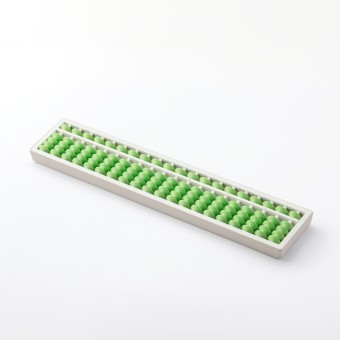
Soroban Colette Abacus by Toshihiko Sakai |
Home > Winners > #161708 |
 |
|
||||
| DESIGN DETAILS | |||||
| DESIGN NAME: Soroban Colette PRIMARY FUNCTION: Abacus INSPIRATION: The abacus was introduced to Japan as calculator 450 years ago, and is popular even today as a traditional skill learning and brain training for children. However, as the design variations are limited because it is made of wood and traditional manufacturing process, children are currently unable to choose one that suits their preference. Manufacturing sites are facing problems such as aging of craftsmen, lack of successors, and less materials, and this shows the possibility that traditional abacus education will be reduced due to the shortage of abacuses, “sorobans” in Japanese. It is also required that newly developed products are eco-friendly. UNIQUE PROPERTIES / PROJECT DESCRIPTION: Previously, the abacus had square corners, but it has been reborn to gentler design having rounded corners so that children can use it without worrying about damaging something with the item. The design does not use screws, nails, or adhesive, making it a highly safe product for younger children. By having a variety of colors that children like, the options have expanded. Additionally, the number of parts has been reduced by 40%, making manufacturing simpler and more efficient. OPERATION / FLOW / INTERACTION: An abacus is designed to make it easy to understand the decimal system, with each column representing one digit. The thing that runs horizontally and divides the bead into one and four parts is called a beam. The beads at the top of it are called 5-beads, and correspond to five beads at the bottom. Use your thumb to move a 1-bead, and your index finger to move the rest. With this small abacus, users can add, subtract, multiply, and divide. PROJECT DURATION AND LOCATION: The project was started in January, 2021, and was completed in April, 2024, It took 3 years for us to reserch and realize an ideal product. |
PRODUCTION / REALIZATION TECHNOLOGY: Traditionally, abacuses were made from hard, heavy wood such as boxwood, which are endangered species and hard to obtain. Over 60% of the product weight is of upcycled materials. By integrally molding the beam and shaft parts like a fishbone, we succeeded in reducing the number of parts by more than 30% compared to conventional products. With all the efforts combined, we have established manufacturing that does not rely too much on individual craftmen. SPECIFICATIONS / TECHNICAL PROPERTIES: "Traditional abacuses were mostly 23 digits, but this product has 20 digits, making it ideal for beginners. As a result, it is now A4-sized and can be stored neatly in a school bag. The main body is made of resin, which is stably supplied, and the weight as well as the size are similar to those of conventional products. Number of digits: 20 Material: main body from recycled polycarbonate, beads from polystyrene Package: paper box with a cover case Weight: 158g Length 60mm x width 283mm x height 17mm" TAGS: pop, colette, eco, 20 digit, colorful RESEARCH ABSTRACT: The traditional manufacturing of abacuses is a cottage industry, involving nearly 200 steps, each of which is highly specialized, requiring a large number of workers to manufacture one abacus. Due to the decrease in successors, the production volume has dropped to about 150,000 per year, about one-twentieth from the peak of 3 million abacuses, making it difficult for abacus schools to secure the necessary quantities. In addition, the raw material ebony is dependent on imports, and domestic boxwood is rated as endangered on the Fukuoka Prefecture Red List, making it depleted and in need of protection. CHALLENGE: A modern arrangement has been added without disrupting the traditional use of the abacus. Additionally, since it will be used by children, we aimed for a safe design with no angular corners and no screws or nails. The most time-consuming task was to come up with a frame structure that integrated the beam and shaft in order to reduce man-hours. In terms of materials, from a sustainability perspective, we had to maintain enough strength while using recycled resin, which was a challenge. ADDED DATE: 2024-04-30 06:19:49 TEAM MEMBERS (1) : Toshihiko Sakai IMAGE CREDITS: N/A PATENTS/COPYRIGHTS: Patent applied Patent application 2023-176919 |
||||
| Visit the following page to learn more: https://ap-asahi.com/colette/ | |||||


| CLIENT/STUDIO/BRAND DETAILS | |
 |
NAME: Asahi Printing Co., Ltd. PROFILE: Asahi Printing Co., Ltd. is a printing company founded in 1953 targeting abacus schools in Japan. In addition to printed materials, the company also sells abacus education-related items. In recent years, it has also been developing computer software as well as mobile applications related to abacus education and provide consulting services for abacus school management along with comprehensive support for them. Conventionally, many of the abacuses sold in Japan are made by specialized skilled craftsmen. However, since April in 2024, the company has entered the field of abacus manufacturing in earnest. |

| AWARD DETAILS | |
 |
Soroban Colette Abacus by Toshihiko Sakai is Winner in Art and Stationery Supplies Design Category, 2024 - 2025.· Read the interview with designer Toshihiko Sakai for design Soroban Colette here.· Press Members: Login or Register to request an exclusive interview with Toshihiko Sakai. · Click here to register inorder to view the profile and other works by Toshihiko Sakai. |
| SOCIAL |
| + Add to Likes / Favorites | Send to My Email | Comment | Testimonials | View Press-Release | Press Kit |
Did you like Toshihiko Sakai's Art Supplies Design?
You will most likely enjoy other award winning art supplies design as well.
Click here to view more Award Winning Art Supplies Design.
  |
 |