
Nabit DNA Testing Kit by Cambridge Consultants |
Home > Winners > #158490 |
 |
|
||||
| DESIGN DETAILS | |||||
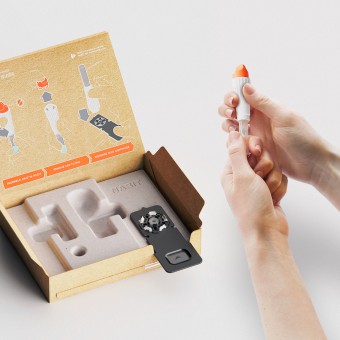
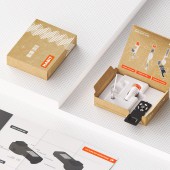
| DESIGN NAME: Nabit PRIMARY FUNCTION: DNA Testing Kit INSPIRATION: Every year, millions of tons of seafood, timber, and wildlife products are trafficked illegally, often disguised in processed form. The rate of new diseases crossing the species boundaries has intensified and now emerging disease threatens more ecosystems and more people than ever before. Genetic analysis is not readily available in the places where it is most needed: in the field. To date, genetic analysis is not: - Easily accessible by those who need it - Usable without a fully equipped lab and technical training - Affordable enough to be put to regular use UNIQUE PROPERTIES / PROJECT DESCRIPTION: Real-time genetic diagnostics by anyone, anytime, anywhere To empower those on the front lines of conservation, Conservation X Labs has built an innovative tool that places the power of a genetics lab in anyone’s hand. The NABIT (Nucleic Acid Barcode Identification Tool) is a low-cost, hand-held, field-ready automated tool to validate the identity of a wildlife or food product, anywhere in the world, without specialized training, equipment, reagents, or even continuous power. By providing conservationists with genetic testing on the front lines, the NABIT can address the underlying drivers of extinction to prevent seafood fraud, illegal fishing, wildlife trafficking, the spread of disease, and more. Furthermore with the new NABIT test kit design this vital conservation work can be done in a more sustainable way. OPERATION / FLOW / INTERACTION: The new All-in-one test kit design makes collecting a sample and running a genetic test much simpler. Users swab a sample into a lysis tube. The tube is then capped with a dispenser tip containing a chamber of diluent. The sample liquid is then heated in the handheld NABIT tool. Diluent is added to the lysis sample in a single step when the user removes the dispenser cap after heating. Users then press the assembly down into a test cartridge to transfer the sample for testing. PROJECT DURATION AND LOCATION: The project started in September 2023 and was concluded in February 2024, development was conducted in both Cambridge, United Kingdom and Seattle, United States. |
PRODUCTION / REALIZATION TECHNOLOGY: The NABIT system existed as a first-generation prototype that had been successfully tested in the field. The core Nucleic Acid Barcode Identification technology has been proven. The single use test kit part of the system needed to become more sustainable and easier-to-use to maximise adoption of the technology and enable vital conservation work. Our team ran a dedicated design sprint to re-imagine and re-design the kit design to significantly improve sustainability and usability. SPECIFICATIONS / TECHNICAL PROPERTIES: Width 154mm, Depth 120mm, Height 30mm TAGS: Sustainability, Packaging, Test Kit, Design, Service Design, Conservation, Testing, Research, Usability, Interaction RESEARCH ABSTRACT: To redesign the NABIT testing kit various methods were used. LCA analysis was used to understand the environmental impact of the existing design and identify the biggest opportunity areas to improve sustainability. In conjunction with this, multiple rounds of user testing have been conducted to improve the flow of the kit and improve user experience, reducing the potential for errors. LCA was then used to evaluate new design ideas to reveal their sustainability impact. CHALLENGE: The most difficult aspect of the redesign was fundamentally changing the way liquid moves around the system and is prepared for testing. To do this a brand-new mechanical All-in-one device was developed. Only by designing this new device were we able to significantly reduce plastic and packaging materials. Another challenge was ensuring that our new device made the process much easier to perform whilst removed substantial amount of material from the test kit. ADDED DATE: 2024-02-20 16:39:59 TEAM MEMBERS (12) : Adam Haynes, Harry Moorman, Henry Blower, Natasha Commins, Niven Curtis Woodcock, Damien Cosgrove, Carlos Tribuna, Isobel Ashby, Anthony Robinson, Hal Holmes, Gareth Fotouhi and Cifeng Fang IMAGE CREDITS: Image #1: Photographer Harry Moorman, Cambridge Consultants, NABIT, 2024. Image #2: Cambridge Consultants, NABIT, 2024. Image #3: Cambridge Consultants, NABIT, 2024. Image #4: Cambridge Consultants, NABIT, 2024. Image #5: Photographer Harry Moorman, Cambridge Consultants, NABIT, 2024. |
||||


| CLIENT/STUDIO/BRAND DETAILS | |
 |
NAME: Cambridge Consultants PROFILE: We are world-leaders in disruptive innovation and technology-based consulting. |

| AWARD DETAILS | |
 |
Nabit Dna Testing Kit by Cambridge Consultants is Winner in Sustainable Products, Projects and Green Design Category, 2023 - 2024.· Read the interview with designer Cambridge Consultants for design Nabit here.· Press Members: Login or Register to request an exclusive interview with Cambridge Consultants. · Click here to register inorder to view the profile and other works by Cambridge Consultants. |
| SOCIAL |
| + Add to Likes / Favorites | Send to My Email | Comment | Testimonials | View Press-Release | Press Kit |
Did you like Cambridge Consultants' Sustainable Product Design?
You will most likely enjoy other award winning sustainable product design as well.
Click here to view more Award Winning Sustainable Product Design.
  |
 |