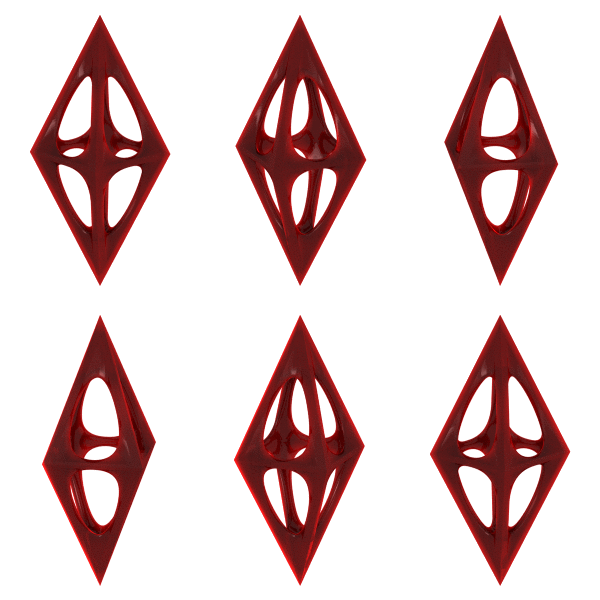
Nautilus Vase by Sebastian Wac |
Home > |
 |
|
||||
| DESIGN DETAILS | |||||
| DESIGN NAME: Nautilus PRIMARY FUNCTION: Vase INSPIRATION: Nautilus Vase has been inspired by the nature of the ocean. Such animals as nautiluses, corals, and sponges, as well as phenomena like bubbles or foam. UNIQUE PROPERTIES / PROJECT DESCRIPTION: Reflection of nature in mathematics and modern technologies, such as parametric modelling and 3D printing, have enabled the creation of tailored variants. Thanks to a created generative algorithm, you can easily modify the surface pattern, scale, colour and thickness of material and generate a model ready for 3D printing in a specific technology. It is possible, for example, to create a model for multi-colour printing, to increase the size of holes, which allows keeping objects requiring the free flow of air, or to completely close the internal surface of a pattern, e.g. to keep flowers in water. OPERATION / FLOW / INTERACTION: It has been designed for decoration and storage purposes. A complex attention-drawing mesh pattern, giving an impression of something strange, and at the same time, associated with the spiral shape of the seashell, well known from nature. PROJECT DURATION AND LOCATION: The project started in May 2020 in Warsaw. FITS BEST INTO CATEGORY: Computer Graphics, 3D Modeling, Texturing, and Rendering Design |
PRODUCTION / REALIZATION TECHNOLOGY: The first step was to create a parametric generative algorithm in Grasshopper 3D software. Then, sample 3D models were generated, in two sizes, in STL file format, designed for 3D printing in SLS technology, in polyamide material. (Other 3D printing technologies are possible after the proper algorithm configuration.) Printability was checked in Shapeways tools. Renders were created in the native Rhinoceros 3D render engine. SPECIFICATIONS / TECHNICAL PROPERTIES: 3D model in STL file format. Polygon count: 991438. File size: 48MB Dimensions: 299 x 191 x 264 mm. Dimensions smaller version: 199 x 127 x 175 mm. TAGS: nautilus, vase, openwork, nature, ocean, shell, coral, bubbles, sponges, parametric, generative, algorithmic RESEARCH ABSTRACT: Finding a unique gift or emphasizing your own individuality is problematic in the modern world of mass production. New technologies come to the aid, such as 3D printing or parametric modelling, which enable fast and relatively cheap creation of personalised items. Due to the high computational power of modern computers and the generative algorithms, you can create much more sophisticated items than before. We can e.g. imitate the chaotic growth of natural organic forms such as corals, or simulate phenomena, such as the formation of bubbles or foam. CHALLENGE: Hardest part was to create efficient enough algorithm to create complex geometry in reasonable amount of time. There was also some trouble with 3D model file requirements and 3D printing restrictions. ADDED DATE: 2020-05-31 08:58:11 TEAM MEMBERS (1) : IMAGE CREDITS: Sebastian Wac, Nautilus Vase, 2020 |
||||
| Visit the following page to learn more: http://www.sebastianwac.com/ | |||||


| CLIENT/STUDIO/BRAND DETAILS | |
 |
NAME: Sebastian Wac PROFILE: By education, Sebastian Wac is a master engineer, specialising in electronic engineering and computer networks. He is a designer by profession, specialising in modelling and 3D printing. In 2014 he set up his own design studio - Protonik, which fulfilled more than 6,800 orders within 4 years of activity. Currently he works as an independent 3D designer. He draws inspiration mainly from organic natural patterns to create jewellery, lighting and other objects. |

| AWARD DETAILS | |
 |
Nautilus Vase by Sebastian Wac is Runner-up for A' Design Award in 3D Printed Forms and Products Design Category, 2020 - 2021.· Read the interview with designer Sebastian Wac for design Nautilus here.· Press Members: Login or Register to request an exclusive interview with Sebastian Wac. · Click here to register inorder to view the profile and other works by Sebastian Wac. |
| SOCIAL |
| + Add to Likes / Favorites | Send to My Email | Comment | Testimonials |
  |
 |