
Seek AI Web Application by Eric Wu |
Home > |
 |
|
||||
| DESIGN DETAILS | |||||
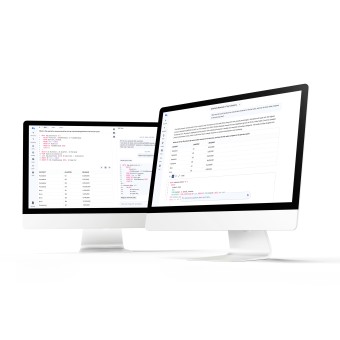
| DESIGN NAME: Seek AI PRIMARY FUNCTION: Web Application INSPIRATION: I have designed this product with the mindset that data tools should be both accessible and efficient. With the rise of generative AI, we're at a unique intersection in design where complex mental models can easily be explained away by AI. However, AI also runs the risk of simplifying things too much and losing accuracy in the process. As a data-centric software, it is paramount that Seek maintains accuracy and precision alongside any usability improvement brought by AI. UNIQUE PROPERTIES / PROJECT DESCRIPTION: Seek is a generative AI platform that empowers business users to query their datasets and frees up data teams from ad-hoc requests for analysis. It automatically converts natural language questions into high-quality SQL code. With the efficiency of Seek, data teams are able to focus more on big questions that matter. OPERATION / FLOW / INTERACTION: With Seek AI, users can ask questions about their data in natural language, and Seek would generate queries for them. This makes it easier for data professionals to write queries for complex datasets. Additionally, Seek allows users to create visualization or share insights with collaborators. PROJECT DURATION AND LOCATION: The project is receiving continuous feature updates. The current iteration was has been developed since the beginning of 2024. FITS BEST INTO CATEGORY: Interface, Interaction and User Experience Design |
PRODUCTION / REALIZATION TECHNOLOGY: Seek AI utilizes large language models to generate queries. SPECIFICATIONS / TECHNICAL PROPERTIES: Seek AI is a web application built with technologies like Next.js, React, and Django. Seek connects to popular data warehouses such as Snowflake, BigQuery, and Redshift. Seek uses a custom agentic AI framework to generate data queries based on natural language questions from the user. TAGS: Generative AI, enterprise application, data analytics RESEARCH ABSTRACT: In the design process, I conducted user research with multiple clients who agreed to be design partners. The research focused on how people perceive accuracy and precision in the context of AI-generated data queries. We found that while people ultimately value precision the most (as they claim), user satisfaction was actually less with a system that is more guardrailed to be precise than making errors. With humanized AI systems, users gain satisfaction from responsive engagement with the system, even though the primary function of the system may be productivity and accurate data queries. CHALLENGE: The challenge was balancing the precision of a data-driven interface with the freedom of an AI chat bot. Research and practice have shown that an entirely uncontrolled AI chatbot performs poorly on structured data, which has low tolerance for any degree of mistakes. On the other hand, user satisfaction greatly increases when the AI has more perceived autonomy and performs more like humans. The design of Seek AI treats the precise SQL editor as an expandable feature within the chat, while also allowing for the option to engage with it solely. A side AI assistant in the editor itself provides the continuity of AI interaction, while acknowledging that in the technical editor interface, AI becomes an assistant to the precision and lets the user take agency. This approach proves to be highly effective as users are able to freely toggle between the two modes of working and ensure that queries are accurate. ADDED DATE: 2024-11-13 00:16:38 TEAM MEMBERS (1) : Eric Wu IMAGE CREDITS: Image credit: Eric Wu Video credit: Eric Wu |
||||
| Visit the following page to learn more: https://www.seek.ai/product-overview | |||||


| CLIENT/STUDIO/BRAND DETAILS | |
 |
NAME: Seek AI PROFILE: Seek AI is on a mission to build AI that can reason over data. What this means for businesses is democratizing data access and break through the information barriers that impede business efficiency. Leveraging proprietary generative AI models and code generation, the simple, accurate and secure platform allows users across organizations to easily request and instantly access vital data. Seek AI aims to eliminate the daily obstacles facing knowledge workers while freeing up data teams by automating routine coding tasks-ultimately optimizing the utilization of organizational data at scale. |

| SOCIAL |
| + Add to Likes / Favorites | Send to My Email | Comment | Testimonials | View Press-Release | Press Kit |
Did you like Eric Wu's Software Design?
You will most likely enjoy other award winning software design as well.
Click here to view more Award Winning Software Design.
  |
 |